
Choosing Sunshade Tarpaulin in 2026 requires more than comparing colors, prices, and advertised thickness. The global tarpaulin sheets market was valued at approximately USD 7 billion in 2023, according to Grand View Research, with demand supported by construction, transport, agriculture, and outdoor living. That growth brings more products, but not always better products.
A reliable selection starts with measurable performance. Check fabric weight, tensile strength, tear resistance, coating type, UV stability, waterproofing, and edge reinforcement. ASTM D751 provides relevant test methods for coated fabrics, while ISO 4892-3 helps evaluate resistance to artificial weathering. These standards cannot predict every outdoor failure. Installation still matters.
Dr. George Havenith, a leading thermal-environment researcher, explains, “Shade changes the thermal environment, but it does not eliminate heat stress.” His point is easy to overlook. A dark, tightly stretched tarp may block sunlight, yet absorb heat and create uncomfortable air beneath it. Ventilation matters.
For a coastal patio, look for UV-resistant polyethylene or PVC-coated fabric, stainless-steel eyelets, and double-stitched hems. For farming, prioritize tear strength and repairability. For temporary events, prioritize flame-performance documentation and secure anchoring.
Do not trust thickness alone.
A thicker Sunshade Tarpaulin can still crack after repeated folding, stretch around weak eyelets, or fade under strong ultraviolet exposure. Product labels are sometimes incomplete. That is where this guide needs caution: laboratory data, field experience, and local climate conditions should be considered together before purchase.
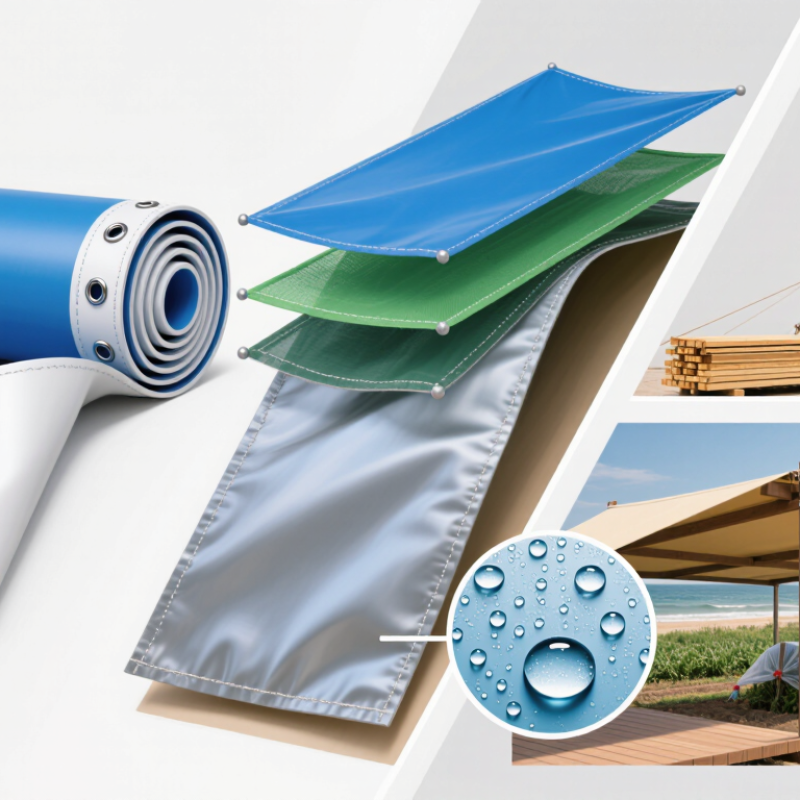
How to Choose Sunshade Tarpaulin in 2026?
Start with your actual shade target. For patios, vehicle areas, and outdoor workspaces, a 90–99% shade factor can reduce harsh sunlight noticeably. However, shade percentage and UV protection are not identical. A dark, dense fabric may create deep shade without proving UPF 50+ performance. Look for independent UPF testing, not only marketing claims. UPF 50+ indicates that the fabric allows no more than one-fiftieth of tested ultraviolet radiation through.
Examine the material closely. Woven polyethylene or polyester tarpaulin should have a tight structure, stable stitching, and reinforced edges. A UV-resistant coating can slow fading and brittleness, especially under strong summer exposure. Check the label. It should identify the shade factor, UPF rating, testing method, fabric weight, and care instructions. I usually hold a sample toward the sun and inspect pinholes, uneven coating, and weak seams. Small flaws become larger after months outdoors.
Installation also affects protection. A stretched panel may leave gaps at the sides, while a low angle can increase reflected light beneath it. Use secure fixing points and allow safe water drainage after rain. I once focused too heavily on fabric density and ignored the mounting layout. The result was cooler, but not evenly shaded. Recheck the site at midday, when sunlight is strongest. Test again after installation.
Choosing a sunshade tarpaulin in 2026 requires more than checking its GSM number. In outdoor installations, I have seen a heavy fabric fail early because its coating became brittle. GSM shows fabric weight, not complete durability. A 280 GSM polyester may perform better than a heavier fabric with weak yarns or poor coating adhesion.
Compare tensile strength in both warp and weft directions. The warp runs along the roll, while the weft crosses it. Uneven strength can cause tearing around eyelets, seams, and tension points. Ask for test values, sample size, and testing conditions.
ISO 4892-3 is also important. It evaluates resistance to fluorescent ultraviolet exposure, moisture, and controlled temperature cycles. It does not automatically prove years of outdoor service. Look for exposure duration, cycle settings, and changes in color, strength, and elongation.
Small details matter. Hold a sample against daylight and inspect coating pinholes. Bend it repeatedly near an edge. Does the surface crack or whiten? A reliable supplier should provide traceable test reports and production specifications. Still, laboratory results have limits. Dust, wind, incorrect tension, and trapped water can shorten service life. I once underestimated seam stress during installation; the fabric itself was sound, but the corner failed. Choose a balanced combination of GSM, tensile strength, UV performance, and practical construction quality.
How to Choose Sunshade Tarpaulin in 2026?
Reliable waterproofing starts with hydrostatic pressure, not a quick water spray. Hydrostatic testing measures how much water pressure fabric withstands before leakage appears. ASTM D751 provides recognized test methods for coated fabrics, but it does not set one universal pass-or-fail value. Therefore, compare results from identical test conditions, fabric samples, and pressure units.
The World Meteorological Organization reported that 2023 was the warmest year recorded, at about 1.45°C above the pre-industrial average. Stronger heat and sudden storms make fabric testing more important. In practical inspections, I check the coating near corners first. These areas often stretch before the central panel does. Heat-sealed seams can reduce needle holes, while stitched seams need tight thread spacing and proper sealing tape. A high hydrostatic number can still mislead. Poor seam construction may cause earlier leakage.
Tips: Ask for the ASTM D751 test method, pressure result, test duration, and fabric conditioning details. Examine seam overlaps by hand. Look for wrinkled tape, exposed stitching, or pinholes. Request a small sample and spray it after folding. Real use is imperfect. Testing should reflect that. When possible, compare the tarp after ultraviolet exposure, because coatings can become brittle before obvious damage appears.
| Waterproofing / Construction Factor | Typical or Recommended Range | What It Indicates | Verification Method | Selection Guidance |
|---|---|---|---|---|
| Hydrostatic pressure resistance | 2–5 kPa ≈ 204–510 mm water head |
Moderate resistance to wind-driven rain and temporary water exposure when the fabric and seams are properly made. | Request the measured pressure, test direction, specimen condition, and failure point from the test report. | Suitable as a general starting point for outdoor shade covers that are not designed for standing water. |
| Higher hydrostatic resistance | 5–10 kPa ≈ 510–1,020 mm water head |
Greater resistance to prolonged or more forceful rain, provided that seams, hems, and attachment points have comparable performance. | Use a documented hydrostatic test on the coated fabric and inspect the finished seams separately. | Preferable for exposed roof-like covers, monsoon climates, and installations with frequent heavy rain. |
| Hydrostatic test interpretation | Higher pressure is generally better, but no universal “waterproof” pass level exists for every application. | A fabric result alone does not prove that a completed tarpaulin is leak-free. | Compare the test pressure, duration, conditioning, and observed leakage with the intended use. | Do not select solely by a large numerical claim without seam and finished-product evidence. |
| ASTM D751 relevance | ASTM D751 covers test methods for coated fabrics, including hydrostatic resistance procedures. | The standard helps create a repeatable laboratory test; it does not automatically define one performance grade for every tarpaulin. | Ask for the edition used, applicable procedure, laboratory identification, specimen details, and numerical result. | Treat “tested to ASTM D751” as incomplete unless the actual method and result are supplied. |
| Heat-welded or radio-frequency-welded seams | Continuous bonded seam with no needle holes | Usually provides better inherent water tightness than unsealed stitching because the coating layers are fused or bonded. | Inspect for continuous bonding, uniform width, open channels, burn-through, wrinkles, and unbonded sections. | A strong choice for rain-exposed covers when the base fabric and coating are compatible with the welding process. |
| Stitched seams with sealing tape | Needle-stitched seam plus compatible waterproof tape or liquid sealant | Can provide good water resistance, but the needle holes and tape adhesion are potential leak paths. | Check tape continuity, edge adhesion, overlap, peeling, skipped stitches, and exposed needle holes. | Acceptable when repairability, flexibility, or material limitations make welding unsuitable. |
| Unsealed stitched seams | Needle stitching without seam tape or sealant | The fabric may resist water while the seam remains a likely leakage route. | Use a spray or controlled water inspection and examine the underside for seepage. | Generally unsuitable where dependable rain protection is required. |
| Seam width and overlap | Follow the fabric supplier’s welding or sewing specification; avoid narrow, irregular, or interrupted overlaps. | Adequate overlap distributes load and gives the seam a continuous water barrier. | Measure representative seams and inspect corners, junctions, and transitions. | Prioritize consistent production quality over an isolated seam-width claim. |
| Hems, eyelets, and reinforcement patches | Reinforced perimeter and stress points with compatible patches and corrosion-resistant hardware | These areas experience concentrated tension and can tear or admit water even when the main panel is sound. | Check patch bonding or stitching, eyelet seating, edge distance, cracks, abrasion, and local deformation. | Essential for large spans, windy locations, frequent installation, and tensioned shade structures. |
| Finished-product water inspection | No visible leakage at panels, seams, hems, corners, or hardware after installation simulation | Confirms that fabrication and installation details have not reduced the material’s laboratory performance. | Inspect under controlled water exposure with the tarp tensioned as intended; record leak locations. | Use this as a final quality-control step rather than relying only on fabric certificates. |
| Drainage and installation angle | Provide a positive slope and avoid low points where water can collect. | Standing water increases load and may exceed the intended hydrostatic and structural performance. | Review the installed geometry, tension, drainage path, and support spacing. | Even high-resistance fabric should not be treated as a pond liner or designed for unrestricted water storage. |
How to Choose Sunshade Tarpaulin in 2026?
Fire performance should guide your tarpaulin choice, not color or price. EN 13501-1 classifies construction products by reaction to fire. Ratings range from A1 and A2 to B, C, D, E, and F. Smoke production uses s1, s2, or s3. Burning droplets use d0, d1, or d2. A specification such as B-s1,d0 indicates limited flame spread, low smoke, and no flaming droplets. Ask for evidence.
A test report alone may not satisfy local requirements. Municipal rules can differ for outdoor canopies, public walkways, markets, schools, and temporary structures. Some authorities require certified assemblies, flame-retardant treatment records, or minimum clearances from buildings. Confirm the required rating before ordering. A local fire consultant or building official can interpret the current code. Do not guess.
Material selection must include seams, ropes, coatings, and support systems. A compliant fabric can perform poorly when stitched with untreated thread or installed against hot lighting. Check the product’s declaration, test method, validity, and intended application. Outdoor exposure also matters because ultraviolet light, moisture, and dirt may reduce performance. Ask how maintenance affects fire behavior. Real installations often reveal gaps between laboratory results and site conditions. I have learned that paperwork is useful, but inspection details matter more. Check the seams.
This chart presents the EN 13501-1 reaction-to-fire classes in their recognized order, from A1 (highest reaction-to-fire performance) to F (lowest or unclassified performance). The numeric values are an ordinal reference scale, not a measured percentage or laboratory test result.
When selecting sunshade tarpaulin, request a valid test or classification report. Depending on the application, local building codes may also require smoke production ratings (s1–s3) and flaming-droplet ratings (d0–d2). Minimum requirements vary by jurisdiction, building type, location, and installation method.
Choosing a sunshade tarpaulin in 2026 starts with the opening, not the fabric color. Measure length, width, corner heights, and nearby obstructions. Record each measurement twice. Small errors become large tension problems. For a rectangular area, calculate the finished coverage first. Then reserve a 10–15% installation allowance for hems, edge reinforcement, overlaps, and adjustment. This allowance is not extra shade area. It is working room.
Wind changes the hardware decision. Exposed roofs, coastal sites, and tall buildings need a site-specific wind assessment. Do not select fittings from fabric size alone. Use rated anchors matched to concrete, steel, timber, or masonry. Turnbuckles should allow tensioning without over-stretching the cloth. Every corner needs a clear load path to a post or structural anchor. Stainless steel resists corrosion, while galvanized components can suit protected inland locations. Confirm compatibility between metals; galvanic corrosion is easy to overlook.
A practical layout often uses unequal corner heights to drain rain and reduce flutter. Keep fabric edges clear of sharp masonry and hot exhausts. The 10–15% figure is a guide, not a universal rule. Some installations need less; complex corners may need more. I would rather revise a drawing than force a tight panel onsite. That lesson is easy to ignore. Have a qualified installer verify anchors, pretension, drainage, and local requirements before final fabrication.
No. GSM measures fabric weight, not total service life. A 280 GSM fabric may outperform heavier material with weak yarns. Coating quality matters too.
Warp strength runs along the roll. Weft strength crosses it. Uneven values may cause tears near eyelets, seams, and corners. Ask for test conditions.
It measures resistance to fluorescent ultraviolet exposure, moisture, and temperature cycles. Request exposure duration and cycle settings. Check color, strength, and elongation changes. It does not guarantee a specific outdoor lifespan.
Hold it against daylight and look for coating pinholes. Bend an edge repeatedly. Watch for cracking or whitening. Small defects can become large leaks.
Ask for the EN 13501-1 classification and complete test evidence. Ratings include flame spread, smoke, and flaming droplets. For example, B-s1,d0 indicates limited flame spread and no flaming droplets. Local rules may still require more.
Yes. Threads, ropes, coatings, and supports are part of the installation. Untreated stitching may weaken overall performance. Hot lighting and poor maintenance can create problems. Check the complete assembly.
Reserve about 10–15% for hems, reinforcement, overlaps, and adjustment. This is working room, not extra shade coverage. Measure length, width, heights, and obstructions twice. Small errors matter.
Use anchors rated for the actual concrete, steel, timber, or masonry. Turnbuckles should allow tensioning without overstretching. Unequal corner heights can improve drainage and reduce flutter. I once underestimated corner stress. The fabric was sound, but the corner failed.
Dust, wind, trapped water, and incorrect tension can shorten service life. Sharp masonry may cut the edges. Hot exhausts can damage coatings. Laboratory results are useful, but they are not the whole site story.
Choosing the right Sunshade Tarpaulin in 2026 starts with defining the level of shade and UV protection required. For strong outdoor comfort, look for a shade factor between 90% and 99% and UPF 50+ performance. Compare fabrics using measurable specifications such as GSM, tensile strength, and resistance to accelerated UV exposure, including testing aligned with ISO 4892-3. These details help determine durability, stability, and expected service life in demanding weather conditions.
Waterproofing should also be evaluated through hydrostatic pressure results, reinforced seam construction, and applicable ASTM D751 testing. Fire safety is another essential consideration, so check EN 13501-1 classifications and any requirements that apply to the installation location. Finally, select a suitable size, anchoring system, and hardware based on expected wind loads. Allowing approximately 10–15% extra installation space can improve tension, drainage, and overall performance while reducing stress on the fabric and fixing points.
