
Top 10 Custom Tarpaulin Types for Global Buyers?
Choosing the right Custom Tarpaulin is more complex than comparing fabric thickness or price. Global buyers must consider weather, cargo shape, handling frequency, and expected service life. A cover used beside a humid port needs different protection from one covering machinery in a dry inland yard. Small details matter. Eyelet spacing, seam construction, coating quality, and repair options can affect daily performance.
UNCTAD’s Review of Maritime Transport 2024 states that more than 80% of global merchandise trade by volume moves by sea. This figure highlights the importance of dependable cargo protection during long exposure to wind, salt spray, and heavy rain. The International Organization for Standardization also provides relevant quality frameworks, including ISO 9001 for quality management and ISO 527 for testing plastic materials. These standards do not define every tarpaulin specification, but they support more consistent purchasing decisions.
Industry research from Grand View Research and MarketsandMarkets shows continuing demand for technical textiles, coated fabrics, and protective materials across construction, logistics, agriculture, and outdoor applications. However, market reports often group tarpaulins with broader textile categories. That limitation deserves attention. Regional demand, recycling practices, and product definitions can vary widely. Therefore, this guide compares ten practical Custom Tarpaulin types through material, coating, strength, waterproofing, UV resistance, and application requirements. Buyers should still request samples, test seams, and verify supplier data before placing large orders. A lower quoted price may hide thinner fabric, weaker eyelets, or shorter outdoor durability. There is no universal best option. The best choice depends on the real working conditions.
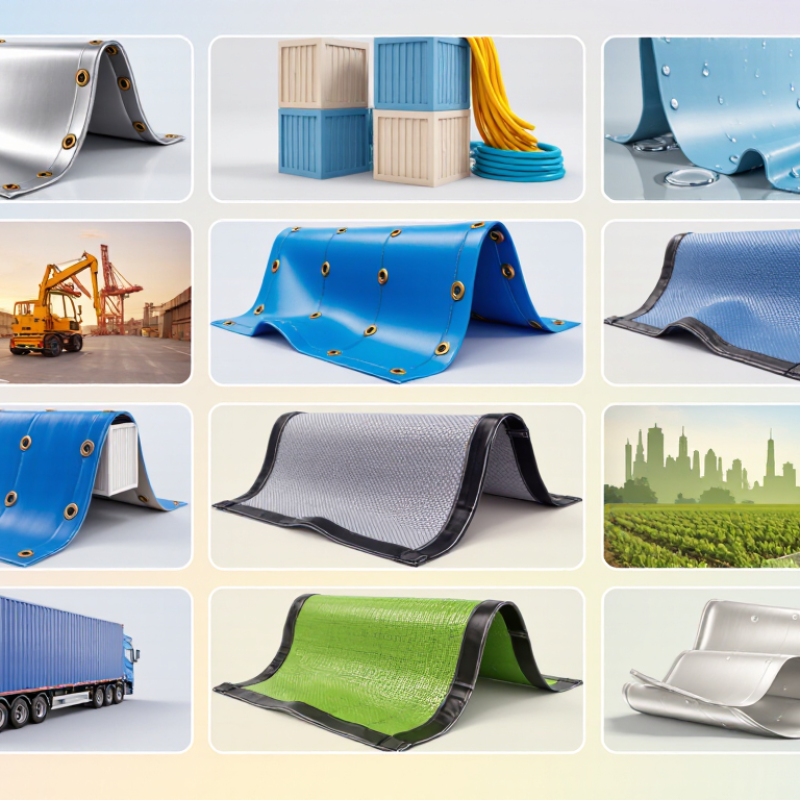
PVC Tarpaulins: 500–1,000 GSM and EN 13501-1 Fire Ratings
Top 10 Custom Tarpaulin Types for Global Buyers
PVC tarpaulins from 500 to 1,000 GSM offer practical strength for demanding outdoor and industrial applications.
The 500–650 GSM range suits truck covers, temporary shelters, and storage partitions.
Heavier 750–1,000 GSM sheets provide better resistance against abrasion, wind stress, and repeated handling.
They also feel noticeably stiffer during installation.
Custom cutting, heat-welded seams, reinforced corners, and corrosion-resistant eyelets can improve service life.
Small details matter.
EN 13501-1 fire ratings require careful verification.
This European classification evaluates reaction to fire, including flame spread, smoke production, and burning droplets.
Ratings may include A1, A2, B, C, D, E, or F, with additional s and d classifications.
A PVC tarp should not be called fire-rated from a supplier statement alone.
Ask for a current test report covering the exact fabric, coating, thickness, and construction.
Different weights may perform differently.
A heavier tarp is not automatically safer.
That assumption causes costly mistakes.
I have seen specifications focus on GSM while ignoring seams, hems, and installation gaps.
Those areas can change real performance.
Reliable buyers should confirm batch traceability, test scope, color stability, tensile strength, and temperature limits.
Fire performance also depends on nearby materials and ventilation.
No fabric replaces a complete safety assessment.
Maybe the specification still needs revision.
That is better than trusting an attractive certificate.
FAQS
GSM means grams per square metre. A heavier fabric is not automatically stronger. Moisture, coating, yarn blend, and sunlight also affect performance.
A 300–400 GSM canvas suits temporary covers, market stalls, and light agricultural storage. It is easier to handle. It may wear faster under wind or rough surfaces.
Choose 500–600 GSM fabric for repeated folding, wind exposure, and abrasive contact. It offers greater resistance, but lifting becomes harder. That detail is easy to miss.
For 300–400 GSM canvas, request about 800 N warp and 600 N weft. For 500–600 GSM fabric, request at least 1,200 N warp and 1,000 N weft. Verify both directions.
Weak hems can fail before the fabric tears. Ask for tested seam strength, reinforced edges, and secure tie-down points. The fabric alone is not enough.
Mesh tarpaulins usually provide 30–90% airflow, depending on weave density and coating. More airflow can reduce wind pressure. It usually lowers water resistance.
Truck tarpaulins need strong fabric, reinforced hems, and correctly placed tie-down points. They protect cargo from rain, dust, and road spray. Poor spacing can cause failure.
No. Heavier sheets may resist tearing but create stronger wind loads. They can also become difficult to lift. I would test real tie-down conditions, not just fabric weight.
Conclusion
Choosing the right Custom Tarpaulin requires matching material, weight, strength, and performance with the intended application. PVC tarpaulins, typically ranging from 500 to 1,000 GSM, provide durable waterproof protection and can be specified with fire performance ratings based on EN 13501-1. PE tarpaulins, commonly between 80 and 250 GSM, offer a lightweight and economical solution, with UV resistance evaluated through ISO 4892-3 for outdoor use.
Canvas tarpaulins generally weigh 300–600 GSM and are selected according to tensile strength, breathability, and durability requirements. Mesh, truck, and shade tarps can be customized for approximately 30–90% airflow while maintaining suitable load performance. Global buyers should also consider ISO 1421 strength testing, coating options, dimensions, edge reinforcement, fastening systems, and the final end use. A well-specified tarp can improve service life, handling efficiency, and protection in transportation, construction, agriculture, and outdoor applications.
