Request a Catalog

Why Choose PVC Tarpaulin for Global Trade?

Time:2026-09-17 Author:Liam
0%

Why Choose PVC Tarpaulin for Global Trade?

Global trade depends on protection that works across ports, warehouses, trucks, and open yards. UNCTAD’s Review of Maritime Transport reports that over 80% of global merchandise trade by volume moves by sea. Cargo may face salt spray, heavy rain, ultraviolet exposure, dust, and repeated handling. PVC Tarpaulin offers a practical barrier against these daily pressures.

Its coated polyester fabric combines tensile strength with flexible handling. A properly welded sheet can cover pallets, machinery, building materials, and agricultural loads. Smooth surfaces also help remove dirt before inspection or storage. In real operations, eyelets, hems, and corner reinforcements often decide whether a cover survives. Small details matter.

The World Bank’s Logistics Performance Index 2023 emphasizes reliability, shipment timeliness, and supply-chain resilience. These priorities make durable cargo covers more than a purchasing detail. They support predictable handling and reduce avoidable exposure during transit. However, no material is perfect. PVC can become less flexible in severe cold, and poor installation may create water pockets. Fabric weight, coating quality, welding methods, and flame-resistance requirements must match the shipment.

Industry buyers should request measurable specifications, including tear strength, coating thickness, UV performance, and temperature range. Independent testing against relevant ASTM or ISO methods improves confidence. A supplier with documented production controls and traceable batch records offers stronger evidence than attractive photographs. PVC Tarpaulin is not simply a plastic sheet. It is a configurable logistics tool, provided its limitations are examined honestly.
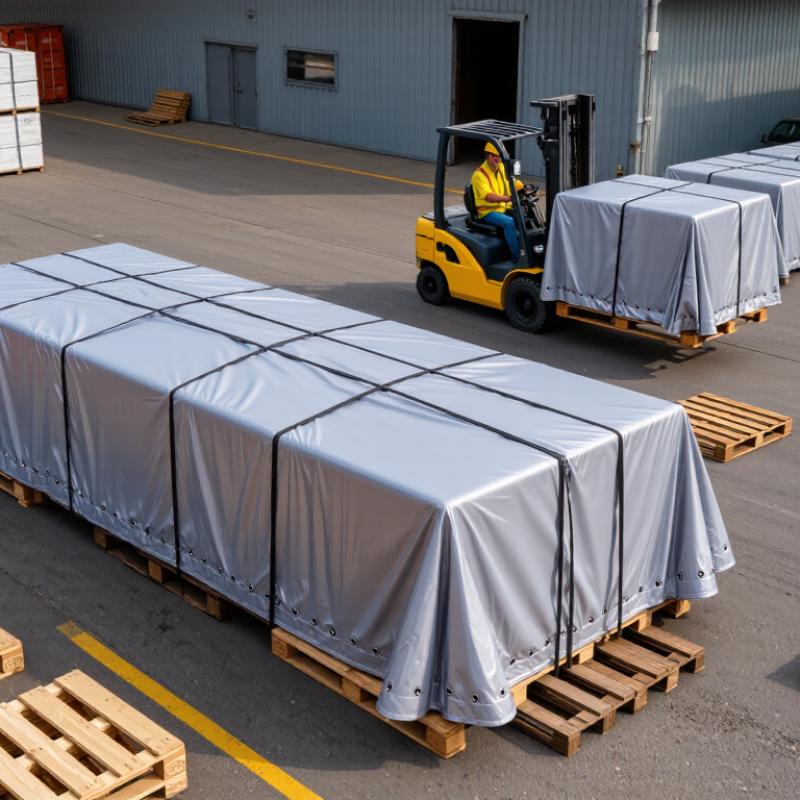
Why Choose PVC Tarpaulin for Global Trade?

What Is PVC Tarpaulin and How Is It Made?

PVC tarpaulin is a flexible coated fabric, not a solid plastic sheet. Its core is usually woven polyester, which provides tensile strength. Manufacturers then coat or laminate both sides with polyvinyl chloride, plasticizers, stabilizers, pigments, and other performance additives. Heat fuses the layers into a continuous surface.

The process sounds simple. It is not.

During calendaring, heated PVC forms a controlled film before bonding with the textile. Coating thickness, fabric density, and curing temperature affect tear strength, flexibility, and waterproofing.

ISO 1421 provides methods for testing tensile strength and elongation in coated fabrics. These tests matter when a cover faces repeated folding, wind, and cargo handling.

Industry data also explains PVC’s broad industrial use. PlasticsEurope’s Plastics—The Facts 2023 reported PVC represented approximately 9.6% of European plastics demand in 2022. That scale supports established processing knowledge and consistent raw-material supply. For global trade, PVC tarpaulin can offer a practical balance of weather resistance, weldability, and manageable weight. It also accepts printing and edge reinforcement, useful for transport covers and temporary storage.

Still, performance is never automatic. A poorly welded seam can fail before the fabric does. Excessive plasticizer may improve flexibility but reduce long-term stability. Product specifications should therefore include coating weight, fabric denier, tensile results, temperature range, and inspection records. The material is durable, but not indestructible.

Which Properties Make PVC Tarpaulin Suitable for Global Trade?

PVC tarpaulin is valued in global trade because it combines protection, flexibility, and practical handling. Its coated surface blocks rain, dust, and accidental splashes during transport. The fabric also remains flexible when folded, making it easier to load into containers or warehouses.

A key property is high tear resistance. Heavy cargo can create sharp pressure points, so reinforced edges and strong eyelets matter. Heat-welded seams can reduce leakage better than simple stitching. PVC tarpaulin also tolerates regular sunlight exposure, although long-term ultraviolet damage should not be ignored. The material is easy to clean after contact with mud, oil, or saltwater. That saves handling time.

In field inspections, I look for coating thickness, seam quality, and consistent color. These details often reveal manufacturing weaknesses. A low-quality sheet may appear waterproof but crack after repeated folding. Temperature flexibility is important too, especially when goods cross different climate zones. Buyers should request tensile strength, tear strength, UV resistance, and temperature data before ordering. Roll width, weight, and packing efficiency also affect freight costs. No specification is perfect for every route. A tarpaulin designed for tropical storage may need different performance from one used on cold-weather cargo trucks. Clear test reports and accurate product descriptions help reduce disputes between suppliers, carriers, and importers.

How Does PVC Tarpaulin Perform in Different Shipping Conditions?

Why Choose PVC Tarpaulin for Global Trade?

PVC tarpaulin performs differently as shipping conditions change. In humid ports, its coated surface resists rain and reduces water absorption. A properly welded seam helps protect cartons during long exposure. Small tears can still grow quickly.

In cold routes, flexible PVC remains useful when the material is selected for low-temperature service. Cheap or poorly stored sheets may stiffen and crack during folding. In hot containers, strong sunlight can raise surface temperatures sharply. Dark cargo covers may become hot enough to affect sensitive packaging. Ventilation and spacing deserve attention.

Wind creates another challenge. A loose sheet can flap against metal edges for hours, causing abrasion. I check grommets, rope tension, and corner reinforcement before loading. Salt spray is less dramatic, but it can collect around eyelets and fasteners. Regular inspection during port transfers is wise. It takes minutes.

PVC tarpaulin also handles repeated handling better than many basic fabric covers. Forklifts, hooks, and rough pallets can still damage it. One overlooked sharp corner can defeat an otherwise strong cover. I have seen this happen. The material is reliable, but not careless-proof. Cleaning dirt before folding also matters, because trapped grit can wear the coating from inside.

Why Choose PVC Tarpaulin for Global Trade? - How Does PVC Tarpaulin Perform in Different Shipping Conditions?

The following table summarizes the typical performance of commercial PVC-coated polyester tarpaulin in common global shipping conditions. Actual results depend on fabric weight, coating formulation, welding quality, construction, and test method.

Shipping Condition Main Exposure Typical PVC Tarpaulin Performance Useful Specification Range Recommended Practice
Sealed container transport Moisture, condensation, dust, repeated handling Provides a continuous waterproof barrier when seams, eyelets, and edges are properly finished. PVC coating also helps resist dirt and routine abrasion. 450–900 g/m² fabric weight; approximately 1,000–3,000 mm water-column resistance for many commercial constructions Dry the cargo before covering and allow ventilation where condensation may form.
Open-deck or exposed sea freight Rain, salt spray, wind uplift, sunlight, and wave-driven moisture PVC-coated fabric is highly water-resistant and can tolerate outdoor exposure better than many untreated textile covers. Mechanical restraint remains essential in high wind. Heavy-duty grades commonly use 650–900 g/m² fabric with reinforced hems and welded or reinforced seams Use closely spaced tie-down points, rounded contact surfaces, and corrosion-resistant fittings.
Hot, sunny routes UV radiation, elevated surface temperature, and thermal cycling UV-stabilized PVC formulations can maintain flexibility and color more effectively than non-stabilized materials, although prolonged exposure eventually causes aging. Select a UV-resistant outdoor grade; typical service temperature is approximately −30°C to +70°C, depending on formulation Confirm the supplier’s UV and temperature rating for long-duration storage or transit.
Cold-climate transport Low-temperature stiffening, folding, impact, and snow or ice loading PVC remains functional in cold conditions when a cold-flexible grade is selected. Bending or folding a frozen cover can increase the risk of cracking. Cold-flexible grades are often specified for service near −30°C; the exact limit must be verified for the product Warm the material before sharply folding, dragging, or tensioning it in sub-zero conditions.
Rainforest or monsoon routes Persistent rain, high humidity, mold risk, and trapped condensation The coated surface does not readily absorb water and is easy to clean. Moisture can still accumulate on the underside if ventilation is inadequate. Waterproof construction with sealed or welded seams; optional anti-fungal treatment may be specified for humid storage Keep the cover elevated from the cargo and provide drainage paths rather than allowing water to pool.
Road and rail transfer Vibration, flapping, edge abrasion, loading equipment, and repeated installation The polyester base fabric provides tensile reinforcement, while the PVC coating helps protect against surface wear. Abrasion resistance depends strongly on fabric weight and tensioning. Typical heavy-duty tensile strength: approximately 1,500–3,000 N/5 cm, depending on construction Use edge protection, avoid loose sections, and inspect high-wear areas after each transfer.
Repeated folding and reuse Creasing, puncture, seam fatigue, and contamination PVC tarpaulin can be cleaned and reused when it is properly dried, rolled or folded without excessive creasing, and stored away from heat and sharp objects. Welded seams and reinforced hems generally offer better durability than unreinforced cut edges Repair small punctures promptly and do not store the material while wet or contaminated with salt.
Oversized or irregular cargo Sharp corners, concentrated loads, wind pressure, and difficult tie-down geometry Flexible PVC-coated fabric can be manufactured in large panels and adapted to different cargo shapes. Its performance depends on correct patterning and reinforcement at stress points. Specify reinforced corners, webbing, additional eyelets, and suitable seam construction for the cargo geometry Use padded contact points and design the cover so tension is distributed rather than concentrated at individual eyelets.
Data note: The numerical values are representative ranges for commercial PVC-coated polyester tarpaulin, not universal guarantees. Test results should be confirmed using the applicable fabric and seam standards, such as ISO 1421 for tensile strength, ISO 4674-1 for tear resistance, and ISO 811 for hydrostatic pressure where relevant.

What Standards and Specifications Should Buyers Check?

PVC tarpaulin remains popular in global trade because it combines weather resistance, flexibility, and practical handling. For buyers, price alone is a weak buying signal. The specification sheet should state the base fabric, yarn density, coating method, finished weight, and thickness. Ask whether the weight is measured before or after coating. That detail matters. A 650 gsm sheet can perform differently when its coating is uneven. During factory inspections, pinholes, stiff edges, and loose selvedges often indicate future handling problems.

Buyers should request tensile strength and tear strength in both directions. Test methods and tolerances must appear beside the results. Common references include ISO 1421, ISO 4674, and ASTM D751, depending on the product and market. Waterproofness needs a measurable hydrostatic pressure result, not only the word “waterproof.” For outdoor covers, check UV resistance, low-temperature flexibility, heat aging, and coating adhesion. If flame resistance is required, confirm the exact classification and certificate for the destination market. Not just GSM. Seam strength also deserves attention because strong fabric can fail at poorly welded joints.

Before shipment, approve a sealed sample and inspect roll width, length, eyelet spacing, corner reinforcement, and packaging. Tolerances should be written into the purchase contract. Request batch numbers, certificates of analysis, and independent inspection reports for larger orders. Standards vary by use and country, so broad compliance claims can mislead. A recurring inspection mistake is focusing on fabric weight while overlooking shrinkage after heat exposure. A small pilot order may reveal odor, curling, weak welds, or inconsistent color before full production.

How Can Businesses Select and Maintain PVC Tarpaulin Products?

PVC tarpaulin suits global trade because it combines waterproofing, tear resistance, and flexible handling. However, selecting the right product requires more than checking its appearance. Buyers should confirm fabric weight, coating thickness, tensile strength, UV resistance, and operating temperature. A heavier sheet is not always better. It may increase transport weight and complicate installation.

For export use, inspect welded seams, eyelet spacing, edge reinforcement, and folding marks. Request technical data, test reports, and clear production specifications from the supplier. The dimensions should match the cargo, allowing enough overlap for secure fastening. In humid ports, mildew resistance matters. In sunny regions, UV protection can prevent early cracking. Check the material before shipment.

Maintenance begins with simple habits. Remove dust and salt with clean water and a soft brush. Avoid harsh solvents, sharp tools, and dragging the sheet across concrete. Let it dry completely before storage. Keep it rolled or loosely folded in a cool, ventilated place. Inspect seams and eyelets after every major trip, especially after strong winds. Small cuts should be repaired early with compatible PVC patches and proper heat welding. A common mistake is storing a damp cover for convenience. It saves minutes, then creates unpleasant damage. Product choice also needs review after real use; local weather, handling methods, and repeated loading may reveal weaknesses that specifications missed.

FAQS

Why is PVC tarpaulin suitable for international shipping?

Its coated surface helps block rain, dust, mud, and accidental splashes. It remains flexible when folded. That makes loading easier in containers and warehouses. It is useful, but not invincible.

Which features should buyers inspect before ordering?

Check coating thickness, fabric weight, tensile strength, tear strength, and temperature range. Also inspect welded seams, eyelets, edge reinforcement, and roll width. A smooth appearance proves little. Request clear test reports.

How does PVC tarpaulin perform in humid or rainy ports?

The coated surface resists rain and limits water absorption. Heat-welded seams usually reduce leakage better than basic stitching. Mildew resistance may matter during long storage. Small tears can still spread quickly.

Can PVC tarpaulin handle cold shipping routes?

It can perform well when designed for low-temperature use. Poorly stored material may stiffen and crack during folding. Ask for low-temperature flexibility data. Cold exposes weak materials.

What problems can heat and sunlight cause?

Strong sunlight can raise the cover’s surface temperature inside a container. Long-term ultraviolet exposure may cause fading, cracking, or reduced strength. Dark covers can become especially hot. Ventilation and spacing deserve attention.

How can businesses prevent wind and abrasion damage?

Inspect grommets, ropes, corners, and reinforced edges before loading. Keep the sheet tight, but avoid excessive tension. Loose material may flap against metal edges for hours. One sharp corner is enough.

How should PVC tarpaulin be cleaned and stored?

Remove dust and salt with clean water and a soft brush. Avoid harsh solvents, sharp tools, and concrete surfaces. Dry the cover completely before storage. Damp storage causes trouble.

How can users extend the product’s service life?

Inspect seams and eyelets after major trips, especially following strong winds. Repair small cuts early with compatible patches and suitable heat welding. Clean grit before folding. I may be overly cautious, but repeated use reveals hidden weaknesses.

Conclusion

Pvc Tarpaulin is a coated fabric made by applying polyvinyl chloride to a woven base, creating a flexible and durable material for covering, protection, and cargo handling. Its strong resistance to water, tearing, abrasion, sunlight, and temperature changes makes it suitable for global trade, where goods may face rain, humidity, dust, wind, long storage periods, and repeated loading or unloading. Different weights, coating thicknesses, surface finishes, and reinforcement levels allow businesses to select products for specific cargo and transport conditions.

Before purchasing, buyers should check dimensions, fabric strength, waterproof performance, temperature range, flame-related requirements where applicable, packaging details, and relevant market or transport specifications. Product quality should also be verified through clear testing information and consistent manufacturing records. To extend service life, businesses should choose the proper specification, avoid excessive tension or sharp contact, clean the surface regularly, dry it fully before storage, and keep it folded or rolled in a cool, ventilated place. With suitable selection and maintenance, Pvc Tarpaulin can provide dependable protection throughout international supply chains.


Liam

Liam

Liam is a dedicated marketing professional with a profound expertise in the industry, where he excels at highlighting the unique advantages of our core products. With a keen understanding of market trends and consumer needs, Liam frequently updates our company’s professional blog, providing......