Standardized & Engineered Solutions Directly Extruded, Woven, and Melt-Laminated in China Manufacturing Plants
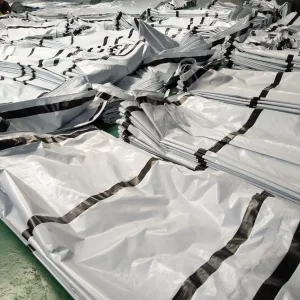
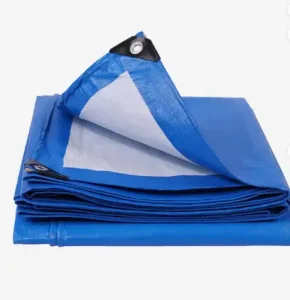
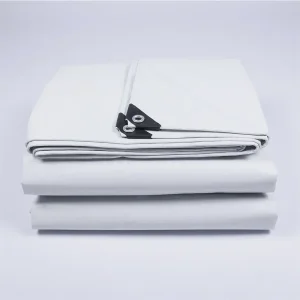
An In-Depth Analysis of Technical Textile Consumption Across Mega-Infrastructure, Logistics Networks, Agritech, and Emergency Containment Sector
The global market for large-format waterproof tarpaulins has evolved from basic temporary coverage solutions into highly engineered polymer containment membranes. Driven by stringent environmental regulations, extreme weather volatility, and intermodal freight expansion, enterprise buyers now demand exact tensile tolerances, hydrostatic pressure resistance exceeding 100 kPa, and extended ultraviolet (UV) stabilization lifetimes (3 to 5+ years field performance).
Modern industrial applications require poly-woven matrix materials that combine high-density polyethylene (HDPE) tape weaving with low-density polyethylene (LDPE) double-sided thermal lamination. In heavy transportation and civil architectural structures, Polyvinyl Chloride (PVC) knife-coated polyester fabrics dominate due to their structural fatigue resistance and weldable structural integrity.
Standard market tarpaulins suffer rapid polymer degradation due to photo-oxidation, thermal stress, and mechanical shear. Leading Chinese industrial clusters—exemplified by enterprise producers such as Linyi Xinshengyang Plastic Products Co., Ltd. (Star Tarpaulins)—utilize advanced masterbatch formulations incorporating Hindered Amine Light Stabilizers (HALS) and Rutile Titanium Dioxide (TiO2).
This technical optimization prevents polymer chain scission under high solar radiation zones (such as Middle Eastern desert environments, Sub-Saharan Africa, and Mining sites in Australia), yielding up to 40% higher tensile retention after 2,000 hours of accelerated Xenon arc weathering (ASTM G155) compared to non-stabilized regional alternatives.
How Vertical Industrial Agglomeration in Linyi, Shandong Delivers Unmatched Economies of Scale and Quality Precision
From virgin petrochemical resin processing (HDPE/LLDPE/PP/PVC) to high-speed yarn tape extrusion, water-jet and circular loom weaving, high-temperature dual-side lamination, sonic welding, and automated eyelet punching—everything occurs within single unified 30,000 m² industrial complexes.
In-house quality control labs continuously monitor melt flow index (MFI), denier density, fabric mesh tightness (8x8 up to 14x14 counts), film thickness tolerances (±2 microns), and heat-seal seam shear strength, guaranteeing consistent performance across 20,000+ metric ton annual production runs.
By leveraging direct access to Qingdao Port logistics hubs, local energy micro-grids, and automated high-output machinery, Chinese manufacturers reduce conversion costs by 15-25% compared to Southeast Asian or South American re-processors, passing true Total Cost of Ownership (TCO) savings to wholesale buyers.
A Technical Decision Matrix for Procurement Officers Sourcing Large Industrial Tarpaulins
| Material Category | Typical GSM Range | Tensile Strength (N/5cm) | Hydrostatic Head | UV Lifespan (Outdoor) | Primary Industrial Use Case |
|---|---|---|---|---|---|
| Lightweight PE Tarp | 60 – 100 GSM | 400 – 650 N | > 50 kPa | 6 – 12 Months | Short-term covers, retail DIY, dust containment, lightweight agricultural wraps |
| Medium/Heavy PE Tarp | 120 – 300 GSM | 750 – 1400 N | > 80 kPa | 18 – 36 Months | Construction scaffolding, hay stack protection, roof repairs, grain bunker lining |
| Laminated PP Tarp | 100 – 250 GSM | 850 – 1600 N | > 70 kPa | 12 – 24 Months | High-rigidity industrial sacks, ground weed barrier membranes, structural pond liners |
| Knife-Coated PVC Tarp | 450 – 900+ GSM | 2200 – 4000 N | > 150 kPa | 5 – 10+ Years | Flatbed truck side curtains, heavy machinery covers, architectural tension structures |
Deploying Industrial-Grade Large Waterproof Tarpaulins Across Severe Operating Environments Worldwide
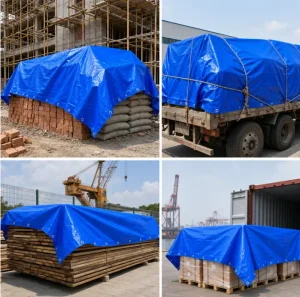
In high-rise construction, mining projects, and bridge engineering, weather protection is paramount to avoiding project downtime. Heavy-duty 200–300 GSM PE flame-retardant sheeting (conforming to EN 13501-1 or DIN 4102 B1 standards) is deployed as vertical scaffold enclosure systems, debris containment nets, and fresh concrete thermal curing blankets. High tensile tear resistance prevents wind-whipping destruction during severe coastal storm events.
Cross-border long-haul freight demands tarpaulin covers capable of withstanding constant aerodynamic turbulence, diesel exposure, and high temperature swings. Custom-fabricated PVC trailer side curtains (650–900 GSM) and 100% virgin polyethylene open-top container liners utilize reinforced sonic-welded webbings, heavy brass eyelets, and anti-abrasion edge strips to ensure cargo integrity across thousands of highway miles.
Large-format tarpaulins are fundamental to modern agricultural efficiency. Multi-season silver/black co-extruded covers reflect radiant solar heat on top while maintaining complete optical opacity below, protecting harvested grain bunkers, livestock fodder, and silage pits from microbial degradation. Additionally, chemical-resistant heavy PE sheets are customized as non-toxic geomembrane liners for agricultural irrigation reservoirs and aquaculture ponds.
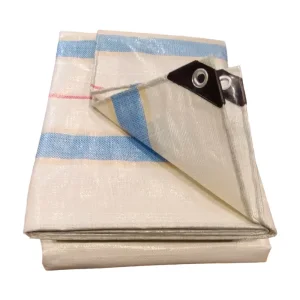
During natural disasters and humanitarian crises, global aid organizations (UNHCR/UNICEF/Red Cross) require immediate dispatch of thousands of standard emergency shelter tarpaulins. Pre-tested double-white or white/grey 190 GSM reinforced sheets equipped with anti-tear corner patches and continuous rope-reinforced hems provide life-saving weather protection under extreme field conditions.
Ensuring Every Roll and Sheet Meets Exact International Technical Standards Prior to Export Shipping
Virgin HDPE resins are melted, extruded into thin micro-films, and slit into uniform flat yarns. Precision tension controllers ensure consistent dtex values and high initial molecular alignment for maximum tensile strength.
Yarns are woven on high-speed circular and flat water-jet looms into high-density base fabrics (mesh counts from 8x8 to 14x14 strands per inch), guaranteeing dimensional stability under multi-directional loads.
Base fabrics pass through mirror-polished lamination rollers where molten LDPE layers containing UV inhibitors, pigment colorants, and flame retardants are thermally fused to both surfaces, creating an impermeable barrier.
Large tarpaulin dimensions are joined using computer-controlled hot-air automatic welding equipment, creating welded seams that exhibit 100% water tightness and shear strength equivalent to the virgin fabric.
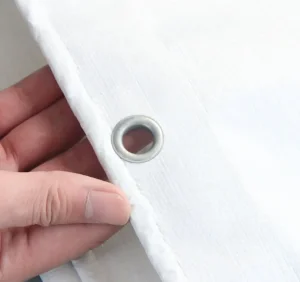
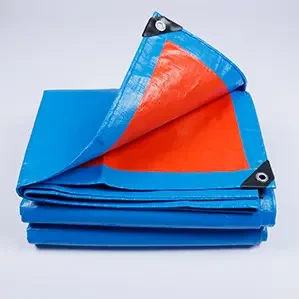
Standard fabrication includes perimeter hem folding with embedded polypropylene inner ropes, triangular molded plastic corner guards, and heavy-duty aluminum or brass eyelets punched at rigid 50cm or 100cm intervals.
Each production run undergoes rigorous sampling for hydrostatic head pressure, grab tensile strength (ISO 13934-1), trapezoidal tear resistance, eyelet pull-out load testing, and color fastness verification.
Tailored Customization Services for Global Hardware Brands, Commercial Distributors, and EPC Project Managers
With global ESG standards tightening across Europe and North America, enterprise buyers are transitioning away from mixed-material composite tarps toward 100% Polyethylene (PE) mono-material solutions. Because the inner base mesh, outer lamination layers, perimeter rope, and corner guards are all synthesized from pure ethylene polymers, the entire tarp can be directly mechanical-recycled into secondary plastic pellets without manual component separation.
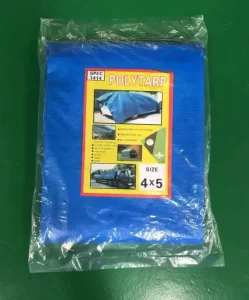
For cross-border e-commerce sellers, retail hardware chains, and commercial distributors, Chinese factories provide comprehensive private-label OEM services. This includes multi-color flexographic surface printing (logos, safety warnings, pitch markers), barcode labelling, individual retail display polybags with header cards, and high-density export bale or carton packing optimized for maximum FCL (Full Container Load) volume utilization.
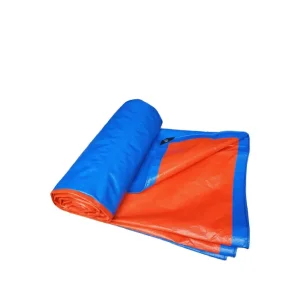
High-Performance Rainproof, UV-Stabilized, and Flame-Retardant Fabric Solutions
Technical Insights & Purchasing Directives Solved by Factory Quality Engineers
Selection depends on mechanical stress, exposure duration, and climate requirements:
For high UV regions such as the Middle East, Northern/Sub-Saharan Africa, Australia, and Arizona (USA), standard plastic films degrade rapidly. Chinese direct manufacturers add 3% to 5% Hindered Amine Light Stabilizers (HALS) combined with Rutile Titanium Dioxide (TiO2) into the outer LDPE extrusion layers. This formulation absorbs and dissipates harmful UV-A and UV-B spectrum radiation, extending polymer chain integrity up to 36+ months under severe solar radiation (>180 kLy/year).
Large-format tarpaulins cannot be woven seamlessly in continuous widths beyond 6 meters on standard looms. Factory engineers utilize automated continuous hot-air welding equipment operating at precise temperature (400°C - 500°C) and compression pressure settings. This thermal fusion bonds the dual LDPE lamination films without scorching the inner HDPE woven matrix, producing a welded seam that meets ISO 13934 tensile standards equal to or exceeding the raw fabric strength.
For standard stocked color specifications (e.g., Blue/Silver, Green/Black, Double White in 120-200 GSM), initial container-mix MOQs start from 3 to 5 metric tons (approx. one 20ft FCL container). Custom engineered orders (specific GSM, custom flame retardancy, special eyelet pitch, or printed branding) require 5 to 10 tons per spec. Standard factory production turnaround is 15 to 25 calendar days following artwork and pre-production sample sign-off.
Enterprise procurement teams should verify factory compliance via accredited third-party testing agencies (SGS, Intertek, TÜV, BV):
Established in 2006 in Lanshan District, Linyi City, Shandong Province, Linyi Xinshengyang operates a 30,000 m² state-of-the-art production base delivering over 20,000 metric tons of PE, PP, and PVC technical textiles annually. By integrating raw yarn extrusion, circular loom weaving, thermal lamination, automated cutting, sonic welding, and internal QC laboratories, Star Tarpaulins supplies premium-grade tarpaulin rolls and readymade sheets to over 40 countries across Europe, the Americas, Middle East, and Africa at factory-direct pricing.