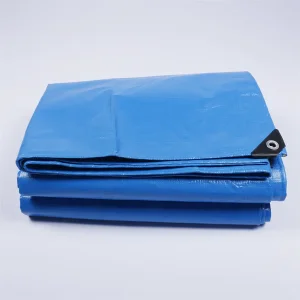
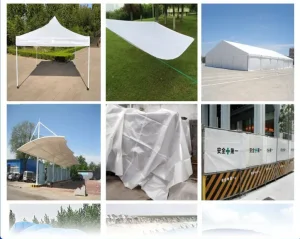
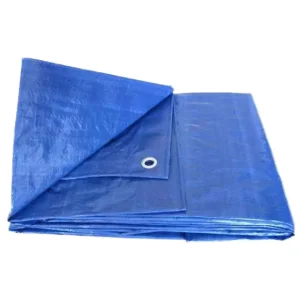
Explore our flagship heavy-duty polyolefin protective coverings, engineered with multi-layer extrusion technology, advanced UV stabilization, and reinforced tear resistance for industrial procurement.
The global landscape for industrial protective coverings and modular flooring substrates is undergoing a profound structural transition. Driven by surging infrastructural development in the Global South, rigorous climate resilience mandates in Northern Europe, and expanding agricultural logistics networks in North America, procurement directors are increasingly moving past traditional regional sourcing models. Instead, enterprise buyers are establishing direct partnerships with integrated manufacturing clusters located in China's industrial heartlands—most notably Linyi, Shandong Province.
As a focal point for high-capacity extrusion, precision circular weaving, double-sided lamination, and automated ultrasonic hem-sealing, premier Chinese factories have evolved from simple OEM vendors into end-to-end technical engineering partners. By standardizing high-density polyethylene (HDPE) inner mesh weaving combined with low-density polyethylene (LDPE) outer protective barriers, facilities under the "China Premier Floors And Tarpaulins" framework deliver material engineered to withstand hydrostatic pressures exceeding 100 kPa while maintaining extreme flexural durability from -40°C arctic cold-crack conditions to +80°C desert heat exposure.
Achieving optimal longevity in industrial tarpaulins and heavy-duty protective floor membranes requires deep mastery of polymer formulation. The primary substrate choice between Polyethylene (PE), Polypropylene (PP), and Polyvinyl Chloride (PVC) directly dictates tensile yield strength, elongation profiles, abrasion coefficients, and total cost of ownership (TCO).
Serving as the structural structural core, virgin HDPE granules are extruded into high-tenacity flat tapes. These tapes undergo orientation stretching to align polymer chains, achieving tensile strengths up to 1200 N/5cm prior to circular weaving.
The woven fabric base is fed into dual-head lamination lines where molten Low-Density Polyethylene (LDPE) is co-extruded onto both surfaces. This forms a non-porous, 100% waterproof seal preventing liquid penetration and chemical degradation.
Unprotected polyolefins degrade under solar UV-A and UV-B radiation. Premier factories incorporate Hindered Amine Light Stabilizers (HALS) at dosages between 3% and 5%, creating a sacrificial radical-scavenging barrier that extends outdoor life up to 5 years.
| Performance Characteristic | PE Tarpaulin (Standard / HD) | PP Woven Tarpaulin | PVC Coated Industrial Canvas |
|---|---|---|---|
| Weight Range (GSM) | 60 – 300 GSM | 70 – 250 GSM | 450 – 900+ GSM |
| Tensile Strength (Warp/Weft) | 700 N / 900 N per 5cm | 850 N / 1100 N per 5cm | 2200 N / 2500 N per 5cm |
| Hydrostatic Head Rating | 80 kPa to 120 kPa | 60 kPa to 90 kPa | > 250 kPa (Impermeable) |
| Flexibility at Low Temp (-30°C) | Excellent (Maintains Flex) | Fair (Risk of stiffness) | Requires Special Plasticizer |
| Recyclability Code | Code 2 (HDPE) / Code 4 (LDPE) | Code 5 (PP) | Code 3 (Complex / Vinyl) |
| Primary Market Application | Agri-Covers, Construction Scaffolding | Heavy Bagging, Ground Covers | Truck Side Curtains, Arch Tents |
Enterprise buyers across municipal infrastructure, commercial agriculture, and global logistics require specialized material configurations. Sourcing from a single premier factory capable of adjusting warp density, film thickness, corner patch reinforcement, and eyelet metal selection is critical to risk management.
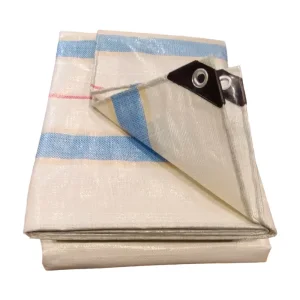
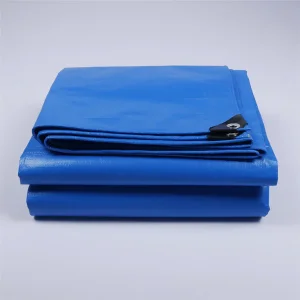
Construction sites demand flame-retardant (DIN 4102 B1 / EN 13501-1 standard) scaffolding enclosures and temporary concrete curing blankets. Reinforced blue/orange and white semi-translucent PE sheets maintain interior site temperatures while preventing debris dispersion.
Long-haul trucking assets face continuous mechanical abrasion and wind-shear stress. Custom 270g+ heavy-duty truck covers, engineered with triple-coated LDPE skins and welded webbing belts, eliminate seam separation during transcontinental transport.
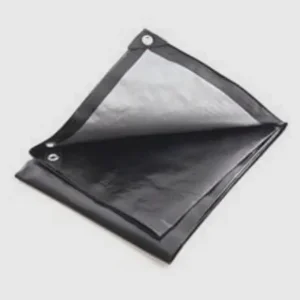
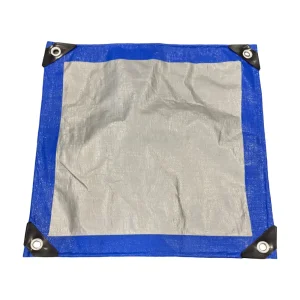
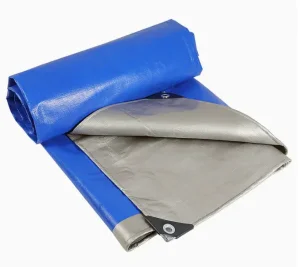
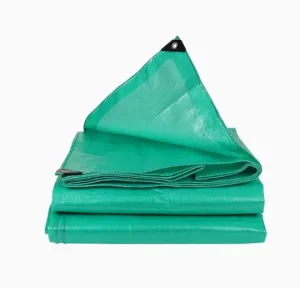
Protection of harvested grain, hay stacks, and silage requires high breathability combined with absolute rainfall rejection. Reversible Green/Silver and Brown/Black double-faced tarps block 99% of solar radiation, reducing internal condensation rot.
Quality control in high-grade plastic polymer production cannot be verified solely at the end of the line. True structural integrity is engineered through an 8-stage vertically integrated manufacturing flow, implemented within our state-of-the-art 30,000 m² factory environment.
100% virgin PetroChina/Sinopec HDPE pellets are combined with color masterbatches and UV HALS additives. Controlled thermal extrusion ensures consistent film thickness and prevents micro-void formation during tape slitting.
Automated circular looms weave flat polymer tapes into dense structural matrices (ranging from 8×8 to 14×14 threads per square inch). Machine vision sensors constantly monitor for warp breakage to ensure zero weaving flaws.
Dual-sided lamination units apply high-temperature LDPE films onto the moving fabric web at speed. Precise pressure rollers merge the molten film with the woven mesh, achieving high bond peel strength.
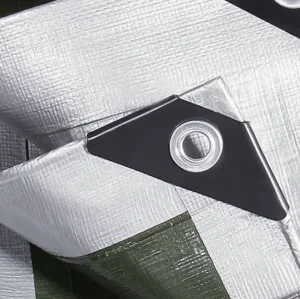
Automated hemming equipment inserts high-tensile polypropylene reinforcement ropes into welded edges. Heavy-gauge solid aluminum or anti-rust brass eyelets are hydro-punched at customer-specified intervals (50cm / 100cm).
For large-scale agricultural and industrial covers exceeding standard fabric roll widths, hot-air or ultrasonic welding channels merge multiple panels into seamless wide-format protection covers.
Every production batch undergoes batch testing: ISO 13934-1 tensile strength analysis, hydrostatic head testing, Mullen burst rating checks, and eyelet pull-out resistance testing before final packaging.
Navigating international trade laws requires strict alignment with global chemical safety guidelines and material standards. Premier Chinese tarpaulin and industrial floor manufacturers prioritize environmental safety and regulatory compliance across all export product lines.
Formulated using eco-friendly stabilizer compounds that meet European Union environmental guidelines, facilitating smooth customs processing across North American and European ports.
Because our PE tarpaulins consist of uniform polyolefin chemistry (HDPE core + LDPE coating), edge trimmings and post-industrial scrap are 100% mechanically recyclable into secondary utility granules.
Full batch traceability is backed by independent inspection documentation from accredited testing bodies including SGS, Bureau Veritas (BV), and TÜV Rheinland upon buyer request.
Answers to critical technical queries frequently raised by enterprise procurement officers, logistics operators, and distributor buyers.
Browse our full range of heavy-duty woven poly products, industrial rolls, agricultural ground covers, and custom vehicle protective solutions available for immediate factory-direct container dispatch.