Precision-manufactured PE, PP, and PVC tarpaulins featuring reinforced hems, UV stabilization, and full customization for global wholesale distributors.
An authoritative deep dive into zero-lux light attenuation, thermal radiation barriers, multi-layer co-extrusion technology, and polymer degradation prevention for high-performance industrial applications.
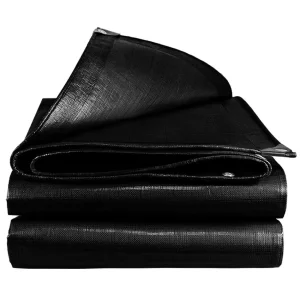
Industrial blackout tarpaulins represent a specialized tier of technical textiles designed to completely eliminate light transmission across the visible spectrum (380–750 nm) as well as near-infrared (NIR) wavelengths. Achieving an absolute 100% blackout (0 Lux transmission) requires a precisely calculated multi-layer composite structure. Unlike standard single-color polyethylene or vinyl sheets, heavy-duty blackout tarpaulin utilizes a co-extruded three-layer or five-layer laminate system.
At the structural core lies a high-density black polyethylene (HDPE) woven scrim engineered with high-denier tapes (typically 800D to 1500D). This woven core is impregnated with high-concentration furnace carbon black masterbatch. Carbon black serves dual functions: it acts as a total photon absorber that captures ambient light photons and prevents light leakage through microscopic interstitial gaps, while simultaneously acting as a primary UV absorber that shields the inner polymer chains from photo-oxidative degradation.
Encapsulating the black inner core are outer lamination layers of Low-Density Polyethylene (LDPE) or Polyvinyl Chloride (PVC) combined with reflective titanium dioxide (TiO2) pigments or metallic aluminum particles. In a classic Black/White or Black/Silver blackout tarp config, the white or silver exterior layer reflects up to 88% of solar radiation, mitigating heat buildup under the tarp, while the inner black layer absorbs remaining energy and guarantees absolute darkout condition within covered enclosures.
Certified Optical Density (OD) rating > 6.0, ensuring zero light penetration even under direct intense sunlight exceeding 100,000 Lux.
Reflective exterior surfaces lower internal ambient temperatures by 8°C to 15°C compared to conventional black tarps, reducing HVAC loads.
Infused with Hindered Amine Light Stabilizers (HALS 622/944) offering robust defense against harsh UV-A and UV-B solar degradation.
Selecting the optimal blackout tarpaulin substrate depends on tensile requirements, flexibility needs, lifespan expectancy, and chemical exposure environments. The three dominant synthetic polymers utilized in high-grade blackout manufacturing are Polyethylene (PE), Polypropylene (PP), and Polyvinyl Chloride (PVC).
| Performance Indicator | Co-Extruded PE Blackout | Heavy Duty PP Blackout | Industrial PVC Coated Blackout |
|---|---|---|---|
| Standard Weight Range (GSM) | 120 GSM – 300 GSM | 140 GSM – 350 GSM | 450 GSM – 900 GSM |
| Tensile Strength (Warp/Weft) | 900N / 800N per 5cm | 1300N / 1100N per 5cm | 2500N / 2200N per 5cm |
| Tear Propagation Resistance | 120 N (Trapezoidal) | 160 N (Trapezoidal) | 350 N (Trapezoidal) |
| Temperature Range | -40°C to +80°C | -20°C to +90°C | -30°C to +70°C |
| Light Transmission (380-750nm) | 0.00% (Absolute Blackout) | 0.00% (Absolute Blackout) | 0.00% (Absolute Blackout) |
| Flexibility & Handling | High (Easy manual folding) | Medium High (Rigid weave) | Flexible (Pliable vinyl finish) |
| Outdoor Field Lifespan | 2 to 5 Years (Climate dependent) | 3 to 5 Years | 7 to 12+ Years |
Delivering tailored environmental control, optical management, and weatherproofing engineered specifically for modern commercial, agricultural, and industrial sectors.
Modern poultry housing requires precise photoperiod management to regulate chicken growth cycles, egg laying frequency, and reduce flock stress. Blackout tarpaulins serve as automated tunnel curtains and sidewall covers, blocking daylight to simulate artificial night periods while maintaining thermal regulation.
High-value horticulture, medicinal plants, and floriculture utilize "light-dep" blackout tarp systems to force early flowering by controlling exact light exposure hours. Our multi-layer breathability options and 100% light shutoff ensure healthy crop yields without heat retention damage.
Sensitive concrete curing, epoxy flooring installation, and emergency weatherproofing demand zero light interference and strict thermal retention. Heavy-duty blackout tarps isolate work areas from ambient sunlight, prevent micro-cracking caused by direct UV radiation, and retain interior climate temperatures.
Intermodal freight, open-top shipping containers, and flat-rack equipment transport face extreme environmental exposure. Silver/Black blackout tarp covers reflect marine sunlight, block ocean spray, eliminate light degradation of sensitive polymers/chemicals, and prevent cargo sweat condensation.
Military field command posts, tactical camouflage shelters, and humanitarian disaster relief centers utilize blackout tarpaulins for thermal infrared (IR) mitigation and night-time light containment, preventing interior illumination leaks during critical operations.
Agricultural bulk storage, grain bunkers, and anaerobic digestion bio-gas covers demand total light deprivation to prevent weed germination, mold development, and photosynthesis-driven spoilage, maximizing nutritional preservation in stored feed.
Every industrial sector operates under unique physical constraints. As a direct manufacturer, Linyi Xinshengyang Plastic Products Co., Ltd. customizes roll widths (up to 6 meters seamless, wider via ultrasonic welding), GSM weights (50 GSM to 900 GSM), eyelet spacing (aluminum, brass, stainless steel from 30cm to 100cm intervals), perimeter internal rope reinforcement, and customized 4-color branding printing.
Inside Linyi Xinshengyang Plastic Products Co., Ltd. (Star Tarpaulins) — vertical integration, automated quality control, and massive production capacity from Shandong's premier plastics hub.
Located in Wanggou Industrial Park, Lanshan District, Linyi City, Shandong Province, our state-of-the-art 30,000 square meter manufacturing facility represents the pinnacle of modern polymer processing. operating since 2006, our plant combines complete vertical integration—from virgin resin processing to final packaging—delivering unprecedented quality stability and cost competitiveness for global buyers.
Advanced extrusion machinery converting virgin HDPE granules into uniform, high-tenacity flat yarn with precise denier control and consistent tensile strength.
Over 200 high-speed circular and flat water-jet looms weaving seamless fabric structures from 6x6 to 14x14 mesh density without structural flaws.
Dual coating extrusion units applying mirror-smooth, pinhole-free LDPE coating layers containing anti-aging additives and UV stabilizers.
Quality assurance is embedded into every operational stage. Every batch of blackout tarpaulin undergoes strict quantitative laboratory testing before container dispatch:
Pioneering sustainable bio-based polymers, nano-scale thermal barriers, and circular economy initiatives for the next decade of technical plastic fabrics.
Transitioning from complex multi-material composites to mono-material Polyolefin (PE/PP) systems. Eliminating structural separation requirements enables 100% closed-loop mechanical recycling without degrading mechanical properties.
Integrating graphene and phase-change material (PCM) micro-capsules into the coating layer to drastically reflect near-infrared solar energy while improving tear resistance by over 35% at lower GSM weights.
Developing next-generation eco-friendly fire retardant formulations compliant with stringent EU REACH and DIN 4102 B1 safety codes without utilizing toxic halogenated additives.
Ensuring flawless international market entry with certified adherence to European, North American, Middle Eastern, and Asian industrial specifications.
Global procurement teams face strict regulatory oversight regarding chemical safety, fire retardancy, and environmental impact. Star Tarpaulins maintains comprehensive compliance documentation, providing lab test reports and certificates alongside every commercial container shipment.
| Compliance Standard | Target Region | Testing Parameters & Scope |
|---|---|---|
| NFPA 701 (Method 2) | North America | Flame propagation testing for heavy-duty architectural & blackout fabrics. |
| DIN 4102-1 B1 / EN 13501-1 | European Union | Self-extinguishing fire performance with zero flammable droplet formation. |
| EU REACH (SVHC List) | Global / Europe | Chemical safety verification ensuring absence of 230+ Substances of Very High Concern. |
| RoHS Directive 2011/65/EU | Global | Strict limits on heavy metals (Lead, Cadmium, Mercury, Hexavalent Chromium). |
| ASTM D751 / ISO 1421 | International | Standard test methods for coated fabric breaking strength, elongation, and hydrostatic burst. |
Optimizing volume order specifications, freight container payloads, OEM private label packaging, and risk mitigation for international B2B buyers.
Shipping woven plastic tarpaulins efficiently requires balancing volume cubic meters (CBM) with maximum payload weight limits (typically 26,000 kg per 40ft HQ container). Standard packing configurations include high-density hydraulic bales for finished sheet tarps and heavy-duty paper core wrapping for master rolls.
Holds approx. 10 to 11 Metric Tons (bale packed PE sheets) or 28 CBM roll stock. Ideal for distributors testing regional market specifications.
Holds approx. 25 to 26 Metric Tons (bale packed) or 68 CBM carton packed. Maximizes ocean freight cost per square meter of fabric.
Custom printed polybags, retail display color inserts, EAN/UPC barcodes, inner master cartons, and branded edge tapes for direct hardware store retail display.
Contact our engineering sales team today for precise GSM recommendations, custom sample dispatches within 72 hours, and container load calculations tailored to your port of destination.
Get Custom Quotation NowIn-depth technical and commercial answers directly from our polymer engineers and export department.
Standard tarpaulins, even dark-colored ones, allow micro-fractions of visible light to penetrate through microscopic gaps between woven tapes or translucent polymer coating layers. A true blackout tarpaulin incorporates an opaque core layer formulated with high-concentration carbon black (furnace process, fine particle size) blended into the internal extrusion matrix or inner coating. This carbon layer completely absorbs incoming light photons, while outer white or silver reflective layers reflect solar thermal radiation, achieving a certified 0.00% light transmission (0 Lux reading) under spectrophotometric analysis.
PE (Polyethylene) blackout tarpaulins are lightweight, cost-effective, 100% recyclable, and ideal for short-to-medium term agricultural (light-deprivation greenhouses, poultry curtains) and temporary construction covers (typically 120–300 GSM). PVC (Polyvinyl Chloride) blackout tarpaulins are heavy-duty, knife-coated synthetic vinyl fabrics (450–900 GSM) with extreme abrasion resistance, hot-air weldable seams, and long lifespan (7–12+ years outdoors), making them the preferred choice for permanent architectural structures, semi-trailer curtains, and industrial containment shelters.
Heat accumulation is prevented by utilizing dual-color co-extrusion technology. We manufacture Black/White or Black/Silver blackout tarpaulins. The outer white or metallic silver surface faces outward toward the sun, reflecting up to 85–88% of infrared solar thermal radiation. The inner black surface faces inward, absorbing internal ambient light and preventing glare. This dual-action design keeps interior ambient temperatures up to 15°C cooler than conventional single-color black tarps.
We incorporate high-grade Hindered Amine Light Stabilizers (HALS) such as Chimassorb 944 / Tinuvin 622 into both the woven core tapes and exterior coating layers at a masterbatch ratio of 3% to 5%. This formulation is calibrated for extreme UV exposure climates (e.g., Middle East, Australia, Sub-Saharan Africa), offering UV resistance ratings up to 500 KLy (Kilo-Langleys), ensuring the tarp maintains over 80% of its initial tensile strength after prolonged sun exposure.
For standard running specifications and colors, our minimum order quantity starts from one 20ft container (approx. 10–11 Metric Tons mixed specs). Custom colors, specific GSM weights, custom grommet configurations, or private label retail packaging require an MOQ of 3 to 5 tons per specification. Standard production lead time is 15 to 25 days following artwork approval and deposit receipt.
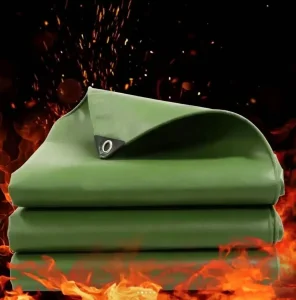
Yes. We manufacture fire-retardant blackout tarpaulins treated with organophosphorus or inorganic flame retardant additives. Our fire-proof series complies with international fire safety codes including US NFPA 701 (Large & Small Scale), European DIN 4102-1 B1, and EN 13501-1 B-s2,d0, ensuring self-extinguishing performance upon removal of the ignition flame source.
Explore our full line of specialized industrial tarpaulins, flame-proof covers, high-strength rolls, and agricultural ground sheets.