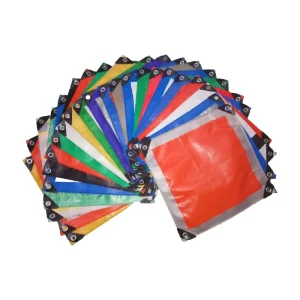
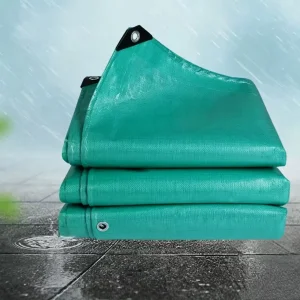
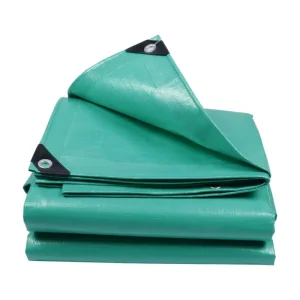
Engineered for high hydrostatic resistance, superior tensile strength, and optimized climate management across commercial industries.
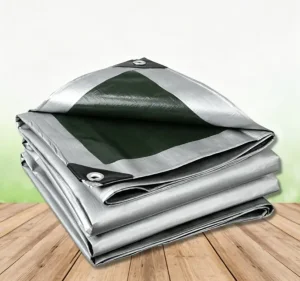
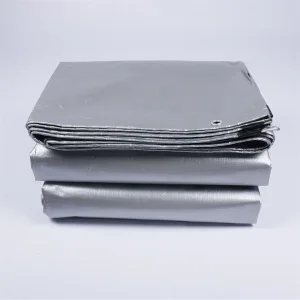
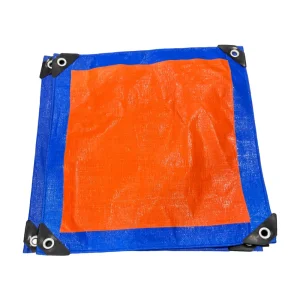
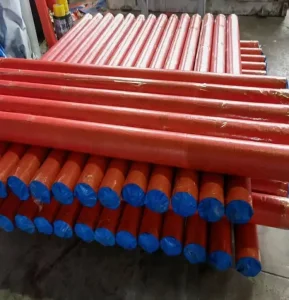
Analyzing global supply chain vulnerabilities caused by trapped condensation, micro-climate condensation damage, and the shift toward technical breathable membranes.
Traditional non-porous PE, PP, and PVC tarpaulins create an impenetrable vapor seal. When wrapped around organic or climate-sensitive commodities—such as kiln-dried lumber, raw agricultural grains, heavy industrial machinery, or outdoor building frames—diurnal temperature swings induce severe condensation, commonly known as "container sweat" or "tarp rot."
Industrial procurement leads, logistics directors, and civil engineering managers are systematically upgrading supply chain standards. The mandate requires protective covers that prevent liquid ingress (rain, snow, ocean spray) while allowing internal moisture vapor to escape continuously.
Modern commercial buyers searching for "Wholesale Breathable Tarpaulin Manufacturer" exhibit complex technical intent beyond simple unit pricing. Search query vectorization shows four primary purchasing vectors:
Understanding the physics of breathable membranes, hydrostatic head balance, and extrusion technology.
| Performance Metric | Standard Coated PE Tarpaulin | Heavy-Duty PVC Knife-Coated Tarp | Engineered Micro-Porous Breathable Tarpaulin |
|---|---|---|---|
| Water Vapor Permeability (WVTR) | Near Zero (< 50 g/m²/24h) | Zero (Impermeable Vapor Barrier) | High (1,500 – 4,500+ g/m²/24h) |
| Hydrostatic Head Resistance | 5,000 – 10,000 mm H₂O | > 20,000 mm H₂O | 12,000 – 18,000 mm H₂O |
| Micro-Climate Dew-Point Risk | Extreme (High Internal Condensation) | Severe (Requires Mechanical Ventilation) | Negligible (Passive Continuous Evaporation) |
| Weight-to-Strength Ratio | Moderate (80 – 220 GSM) | Heavy (550 – 900 GSM) | Optimized High-Tenacity (120 – 260 GSM) |
| Recyclability & Circularity | 100% Polyolefin (PE/PP) Recyclable | Non-Recyclable (Composite Polymer) | Mono-Material Polyolefin Formulations Available |
Breathable tarpaulins utilize a state-of-the-art extrusion matrix blended with sub-micron calcium carbonate (CaCO₃) particles. Upon mono-axial or bi-axial stretching, microscopic voids form around the mineral fillers. These pores are large enough (0.1–1.0 microns) to allow individual water vapor gas molecules to escape freely, yet vastly smaller than liquid water droplets (100–300 microns), maintaining absolute liquid waterproofing.
To withstand severe mechanical stress, industrial breathable tarps combine micro-porous functional films with high-denier High-Density Polyethylene (HDPE) or Polypropylene (PP) woven fabric scrims. Utilizing thermal ultrasonic welding or specialized solvent-free adhesive lamination, the resultant multi-layer sheet yields exceptional tear propagation resistance and high Mullen burst pressure ratings.
Solar degradation is the primary vector for polymer embrittlement. Professional B2B breathable tarpaulins incorporate hindered amine light stabilizers (HALS) alongside titanium dioxide (TiO₂) optical barrier packages. This chemical formulation intercepts free radicals generated by solar UV radiation, extending total outdoor service life to 3–5 years in high-irradiance zones like the Middle East and Australia.
Custom-engineered breathable covering strategies for high-value logistics, building construction, and agricultural preservation.
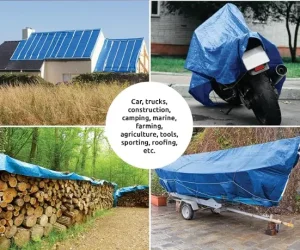
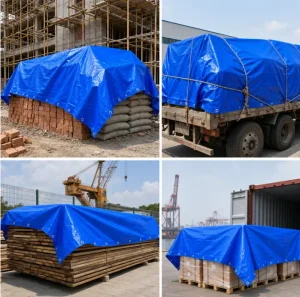
When high-grade dimensional lumber and engineered wood beams are wrapped in non-breathable plastic during flatbed rail or maritime transit, sap staining and fungal growth rapidly occur. Micro-porous breathable lumber wraps allow internal moisture to vent out continuously, preserving wood dryness below 15% EMC (Equilibrium Moisture Content) and avoiding multi-million dollar cargo rejections.
Harvested forage crops and grain mounds release biogenic heat and water vapor. Standard tarps trap this humidity, triggering mold spore proliferation and spontaneous combustion risks. Breathable agricultural covers vent internal thermal updrafts while repelling external torrential rain, locking in nutritional feed values.
During commercial building restoration and roof retrofits, structures remain vulnerable to rain while interior wet trade concrete and plaster dry out. Breathable building membrane tarpaulins serve as temporary structural weather barriers, stopping rain ingress while accelerating indoor structural drying times by 40%.
Precision CNC machinery, automotive exports, and defense gear stored in open-air logistics yards suffer aggressive corrosion under non-breathable plastic sheets due to localized humidity traps. Breathable industrial tarpaulins eliminate relative humidity spikes under the cover, preventing galvanic metal corrosion without costly VCI (Vapor Corrosion Inhibitor) bags.
Strategic engineering shifts driving the next decade of polyolefin film lamination, circular sustainability, and smart active tarpaulins.
Eliminating volatile organic compounds (VOCs) by shifting entirely to solvent-free polyurethane and polyolefin lamination adhesives. Advanced co-extrusion technology enables thinner micro-porous functional core layers (down to 15 microns) without sacrificing hydrostatic head integrity.
Deploying electrospinning technology to deposit ultra-thin polymeric nanofiber webs directly onto woven polyolefin fabrics. This yields unprecedented air permeability and water vapor flux (WVTR > 8,000 g/m²/24h) alongside absolute rainproof capabilities for specialized military and aerospace tarps.
Transitioning away from non-recyclable multi-material composites toward mono-material Polyethylene (PE/PE) and Polypropylene (PP/PP) laminates. This permits post-industrial and post-consumer tarpaulins to be shredded, re-granulated, and melted back into high-grade industrial tarps without manual layer separation.
Integrating flexible printed humidity, temperature, and strain sensors into the tarp hem structure. Real-time telemetry allows logistics managers to remotely monitor micro-climate conditions beneath cargo covers via cellular/satellite gateways.
Direct OEM manufacturing compliance tailored to regional import regulations, climate stress profiles, and retail specifications.
Compliance with REACH SVHC (Substances of Very High Concern), RoHS, and phthalate-free directives. Flame retardancy formulations tested to EN 13501-1 (B-s1, d0) and DIN 4102 B1 for European construction site compliance.
Engineered to meet ASTM E96 (Method B) for water vapor transmission, ASTM D751 for tear strength, and NFPA 701 flame propagation testing. Standardized sizing in feet/inches with heavy-duty brass grommets at 18-inch centers.
Formulated for extreme thermal stability up to +85°C. Reinforced with up to 5% HALS UV additives to withstand 300+ KLY (Kilo-Langleys) annual solar radiation typical of GCC desert environments.
As a vertically integrated manufacturer running extrusion, weaving, coating, printing, and edge-sealing workshops under one roof, we support industrial brand partners with comprehensive white-label production:
Expert insights addressing structural performance, bulk order metrics, testing protocols, and trade logistics.
The core technology relies on micro-porous polymer physics. The microscopic pores inside the microporous film membrane range between 0.1 and 1.0 micrometers (µm) in size. A gaseous water vapor molecule measures approximately 0.0004 µm, allowing it to pass through freely via differential vapor pressure. Conversely, the smallest liquid rain droplet measures around 100 µm, which is thousands of times larger than the membrane pores. Surface tension prevents liquid water from penetrating the fabric, ensuring high hydrostatic pressure ratings alongside vapor breathability.
Standard PE, PP, and PVC tarpaulins are inherently non-breathable sealed barriers because their solid lamination layers block both air and vapor. To achieve breathability, PE or PP woven substrates must be combined with a specialized micro-porous membrane layer during extrusion. Standard PVC tarpaulins cannot easily be made breathable due to dense solid knife-coating processes, making micro-porous PE/PP polyolefin tarpaulins the primary engineered solution for moisture-control applications.
For temporary lumber wrapping and short-transit cargo covers, 80 to 120 GSM breathable wraps offer an optimal weight-to-cost ratio. For long-term agricultural hay covers, scaffolding enclosures, and industrial equipment protection, we recommend 140 to 240 GSM heavy-duty reinforced woven covers. Custom high-tenacity specifications up to 300+ GSM are available for extreme high-wind environments.
For standard stocked roll specifications or basic tarpaulin colors, our base MOQ starts at 3 metric tons per order line (or one full 20ft container mix). For customized specifications involving special colors, precise custom printing, specialized flame retardants, or non-standard grommet spacing, the standard manufacturing lead time is 15 to 25 calendar days post sample and artwork approval.
Every production run undergoes strict Quality Control (QC) logging in our laboratory. We perform hydrostatic head testing (ISO 811 / AATCC 127), Water Vapor Transmission Rate measurements (ASTM E96), strip tensile strength testing (ASTM D5035), tear propagation evaluation (ASTM D1922), and 500-hour accelerated QUV weathering tests. Comprehensive batch test certificates (COA) are provided with every container export.
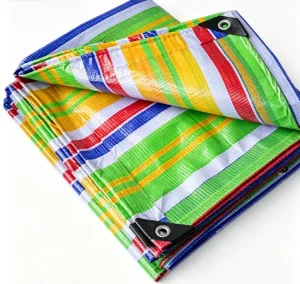
Explore our complete manufacturing portfolio including striped tarps, high-durability truck covers, and agricultural multi-purpose sheets.