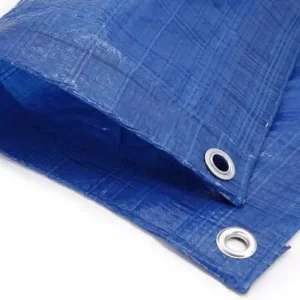
Precision-engineered factory-direct tarpaulin sheets and rolls manufactured to rigorous structural tolerances for global flatbed and industrial containment systems.
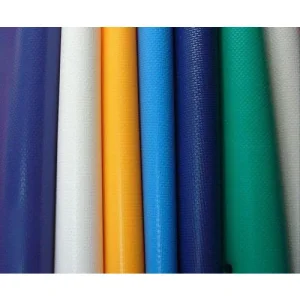
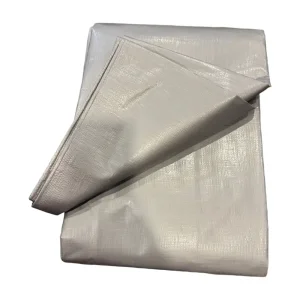
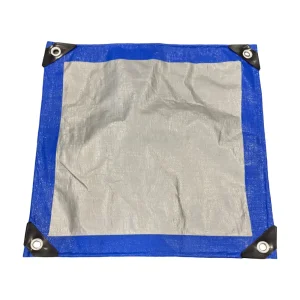

Analyzing the shift from traditional 18oz heavy PVC to high-tenacity lightweight polyolefin matrices in long-haul forestry logistics.
In global flatbed logistics, managing deadweight tare while securing high-value kiln-dried lumber, engineered wood products (EWP), and paper pulp is a core operational challenge. Traditional heavy-duty lumber tarps made from 18 oz/yd² (approx. 610 GSM) cast PVC textiles provide extreme durability but add substantial tare weight to flatbed trailers. A standard set of two 18 oz 8-foot drop tarps can weigh upwards of 115 kg (250 lbs). This heavy physical load increases driver fatigue, elevates risk during deployment at elevation, and reduces maximum allowable net cargo capacity under strict highway axle-load limits.
As an industrial-scale wholesale lightweight lumber tarps manufacturer and factory, our engineering division has reshaped cargo containment paradigms. By synthesizing multi-layer co-extruded High-Density Polyethylene (HDPE) woven scrims laminated with low-density polyethylene (LDPE) or hybrid Polyurethane (PU) films, we deliver engineered tarpaulins that reduce unit weight by 35% to 50% while preserving tear propagation resistance and hydrostatic head integrity.
Drastically lowering the physical burden on flatbed drivers during tarping procedures. Lighter weight reduces rigging time by up to 30%, directly mitigating slip-and-fall injuries on flatbed decks during adverse weather conditions.
Every kilogram saved in trailer equipment converts directly into available payload capacity. For transcontinental fleets, this weight reduction yields tangible freight density improvements and lower carbon footprints per ton-kilometer.
Engineered stiffness prevents high-speed wind flap ("sail effect"), maintaining secure tension across standard 4-foot and 8-foot lumber drop configurations without premature material fatigue.
In-depth breakdown of polymer chemistry, weave density matrices, and surface lamination treatments.
The structural backbone of our lightweight lumber tarps relies on ultra-high-density polyethylene tapes drawn through high-precision extrusion lines. Using virgin grade resin compounded with specialized linear low-density additives, our tape lines produce high-tenacity monofilaments optimized for tensile yield strength.
Our standard lightweight lumber tarp matrix utilizes a 1000D to 1500D scrim woven at an 11×11 to 14×14 threads-per-inch density. This tight weave topology creates exceptional resistance to trapezoidal tearing, preventing tears initiated by sharp lumber corners or steel strap bindings from propagating across the tarp surface.
Water intrusion can ruin kiln-dried structural lumber, causing surface mold, dimensional warp, and rejected shipments. To ensure absolute impermeability, our factory operates multi-stage extrusion coating lines. Both sides of the woven structural scrim are coated with a thermal molten LDPE barrier containing high concentrations of Hindered Amine Light Stabilizers (HALS) and Carbon Black UV absorbers.
| Technical Property | Standard Commercial Tarp | Industrial Lightweight PE Tarp | Heavy PVC Lumber Tarp | Test Method Standard |
|---|---|---|---|---|
| Material Weight (GSM) | 140 – 180 GSM | 240 – 320 GSM | 610 – 680 GSM | ISO 3801 / ASTM D3776 |
| Tensile Strength (Warp/Weft) | 800 / 750 N/5cm | 1650 / 1500 N/5cm | 2200 / 2000 N/5cm | ISO 13934-1 / ASTM D751 |
| Tear Resistance (Trapezoid) | 110 / 95 N | 280 / 250 N | 350 / 310 N | ASTM D4533 |
| Hydrostatic Head Pressure | > 15 kPa | > 80 kPa | > 100 kPa | ISO 811 / AATCC 127 |
| Cold Cracking Threshold | -15°C | -40°C | -30°C | ASTM D2136 |
| UV Degradation Index | 300 Hours QUV | > 3000 Hours QUV | > 2500 Hours QUV | ASTM G154 (Cycle 1) |
Lumber tarps require precise tail flap configurations to seal the front and rear faces of standard 8-foot-tall lumber stacks. Our factory utilizes high-frequency hot-air welding technology for seamless, 100% waterproof joinery. Rather than traditional stitched seams that introduce micro-perforations, welded seams maintain complete structural continuity.
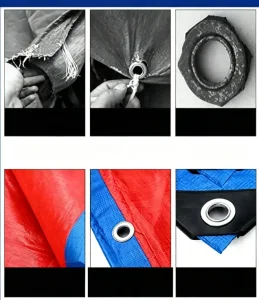
Drop zones feature dual or triple rows of stainless steel or heavy-duty zinc-plated brass grommets set inside double-folded hem lines reinforced with high-tensile polypropylene webbing. Standard spacing at 18-inch (45 cm) or 24-inch (60 cm) intervals allows precise tie-down anchoring with rubber tarp straps (bungees), accommodating varying cargo deck geometry.
Market demand dynamics, international freight compliance standards, and commercial procurement trends across key trade corridors.
The global commercial transport sector is under continuous pressure to reduce operational costs, increase fuel efficiency, and meet stringent safety standards. In North America, Europe, and Australia, regulatory bodies such as the US Department of Transportation (DOT), the Federal Motor Carrier Safety Administration (FMCSA), and European EN 12195-2 load restraint frameworks govern cargo securing protocols.
Lumber transit routes present severe environmental challenges: cross-continental transit between the Pacific Northwest timber mills and eastern distribution hubs exposes tarpaulins to extreme thermal fluctuations—ranging from freezing alpine passes (-35°C) to sun-baked desert highway stretches (+45°C). Industrial fleets and logistics operators require reliable equipment that maintains flexibility and wind resistance across these operational extremes.
High demand for standard 3-piece lumber tarp sets (two 24'x18' tarps with 8-foot drops plus a center tarp). Commercial fleets prefer lightweight hybrid fabrics—specifically heavy-duty PVC tops combined with lightweight PE or PU drop sides—to optimize handling while maintaining deck protection.
Strict European transport regulations emphasize recyclable polyolefin fabrics. Importers and logistics managers prefer single-polymer PE tarpaulins that meet REACH compliance and can be fully recycled at end-of-life without labor-intensive resin separation.
Delivering OEM/ODM customization, rigorous factory audit transparency, and certified international safety compliance.
Our modern 30,000 m² production base operates under ISO 9001:2015 quality control management. We provide full traceability from raw polymer resin batches to finished serial-numbered tarpaulin units.
All formulations comply strictly with REACH (EC 1907/2006), RoHS, and California Proposition 65 standards. Free from SVHCs (Substances of Very High Concern) and toxic heavy metal stabilizers.
We support full OEM private labeling, custom color matching (RAL/Pantone), printed company logos, barcode packaging, and door-to-door (DDP) delivery directly to regional warehouse networks.
Engineered tarpaulins configured for high-stress industrial tasks across construction, forestry, and heavy equipment transport.
Kiln-dried dimension lumber (such as SPF, Douglas Fir, and Southern Yellow Pine) must be kept completely dry during multi-day highway transit. Our lightweight lumber tarps incorporate hydrophobic LDPE coatings that repel driving rain, snow, and road spray while minimizing condensation build-up under high thermal swings.
Long-span Glulam and Cross-Laminated Timber (CLT) panels require oversized protective tarps with deep drop heights (up to 10 feet). Our factory manufactures custom extra-wide tarp assemblies with strategically placed D-ring rows, enabling tight, tailored wraps around irregular structural wood components.
For breakbulk lumber stored at marine terminals or outdoor staging yards, exposure to intense salt fog and UV radiation can degrade standard covers. Our tarps feature high-dosage HALS stabilization, providing extended outdoor service life in harsh maritime environments.
Pioneering smart textiles, circular economy polymers, and advanced nano-composite coatings for the next generation of transport covers.
As a technology-focused manufacturer, our R&D department actively advances technical textile performance across three strategic fronts:
Incorporating graphene nanoplatelets into polyethylene coatings to enhance puncture resistance and abrasion tolerance by up to 40% without increasing nominal weight or reducing flexibility.
Developing 100% single-polymer Polyolefin Tarps (Mono-material PE) featuring matching base fabrics, coating layers, and webbing, allowing complete mechanical recycling without manual component separation.
Embedding passive RFID tags and thin-film humidity sensors into tarp hems, enabling fleet dispatchers and cargo owners to monitor seal integrity and moisture levels in real-time via IoT gateways.
Expert engineering answers to technical procurement questions regarding lightweight lumber tarps.
A standard traditional lumber tarp is fabricated from 18 oz/yd² (approx. 610 GSM) PVC coated polyester fabric, making a typical 24'x28' tarp weigh between 50 kg to 60 kg (110–130 lbs). In contrast, a lightweight lumber tarp utilizes high-tenacity woven HDPE base fabric laminated with LDPE or lightweight PU/PVC hybrids, scaling the unit weight down to 240–320 GSM (approx. 7–9 oz/yd²). This results in a weight reduction of over 40-50%, making deployment faster and safer while allowing trucks to carry more payload under gross vehicle weight rating (GVWR) limits.
While lightweight tarps use thinner material layers, puncture and tear resistance are maintained through high weave density (e.g., 14x14 tapes per square inch using 1000D+ high-tenacity yarn). Additionally, stress points such as corners, drop seams, and tie-down rows feature double-layered reinforcement patches and heavy-duty polypropylene webbing webbing sewn directly into hem lines. For sharp, rough-sawn timber corners, using plastic corner protectors is recommended to maximize tarp longevity.
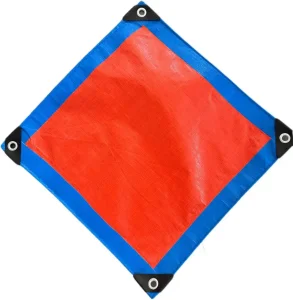
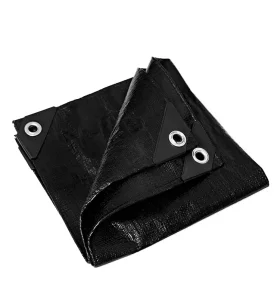
Yes. As an original manufacturer, we offer full OEM/ODM manufacturing. Standard lumber tarp configurations include 8-foot drops (24' x 27.5' or 24' x 28.5') and 4-foot drops (16' x 27.5'), but custom dimensions can be produced to order. We offer dual or triple rows of stainless steel or zinc-plated D-rings with protective rain flaps, custom eyelet pitch (18", 24", 36"), reinforced tail flaps, and custom color options (Black, Blue, Green, Silver, Charcoal).
During resin compounding, we incorporate premium Hindered Amine Light Stabilizers (HALS) and fine-particle Carbon Black masterbatch at precise dosages (typically 3% to 5% by weight). This prevents photo-oxidation and chain scission under solar UV radiation. Our tarps are tested under ASTM G154 accelerated weathering protocols to ensure retention of at least 80% tensile strength after 3,000 to 5,000 hours of continuous UV exposure.
For standard stock specifications, minimum orders start from one mixed 20ft container. For custom colors, specific GSM formulations, or printed corporate logos, our standard MOQ is 3 metric tons per specification. Factory production lead time is generally 15 to 25 days following pre-production sample approval and deposit confirmation.
Yes. Stitched seams rely on needle penetrations that create thousands of micro-holes, which can leak water under driving rain unless sealed with seam tape. Hot-air thermal welding fuses the thermoplastic coatings together at a molecular level, creating a continuous, 100% waterproof join that matches or exceeds the tensile strength of the surrounding parent fabric.
Explore our full line of industrial tarpaulin rolls, pallet covers, and agricultural poly fabric systems.