High-tenacity woven polyolefin fabrics, engineered specifically to withstand the rigors of maritime transit, structural scaffolding, and North Sea coastal weather conditions.
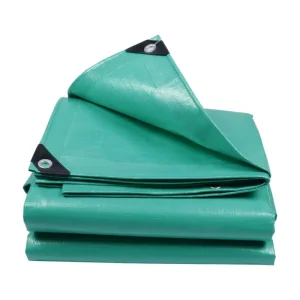
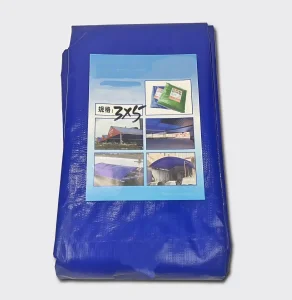
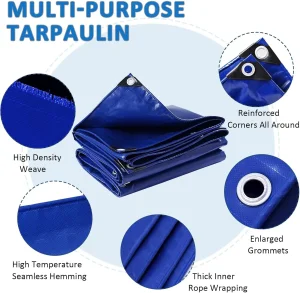
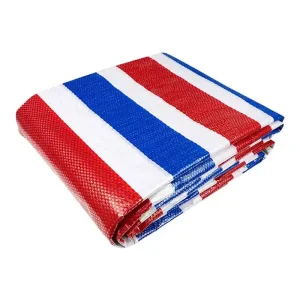
As Northern Europe’s premier railway and maritime logistics node, the Port of Hamburg (HHLA Terminals, Eurogate Hamburg) demands rigorous protective cover standards to shield high-value breakbulk, intermodal container stock, and maritime machinery from harsh North Sea maritime weather systems.
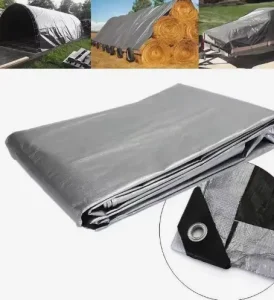
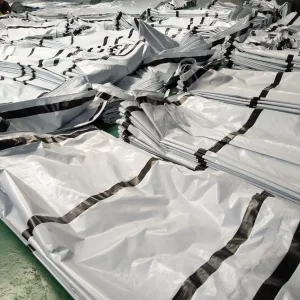
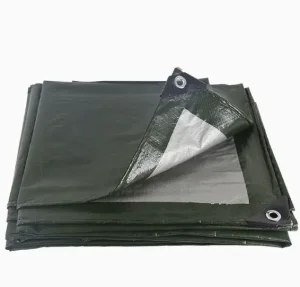
Stripped tarpaulins—characterized by their high-visibility color bands (typically Blue/White, Red/White, or Green/White)—play a dual role in European industrial environments. Beyond standard waterproofing and tear resistance, these specialized striped tarps act as visual safety indicators across busy logistical staging zones, shipyard repair berths along the Elbe River, and major civil engineering projects across HafenCity and the wider Metropolitan Region of Hamburg.
Hamburg experiences an oceanic climate with an average relative humidity exceeding 80% year-round, frequent gale-force winds, and intense atmospheric salt deposition. Our stripped polyolefin tarpaulins utilize high-density polyethylene (HDPE) core weaving coated with low-density polyethylene (LDPE) matrix containing active corrosion-inhibiting UV stabilizers.
In compliance with European Workplace Health and Safety directives (Directive 92/58/EEC), striped tarpaulins serve as immediate visual demarcations for temporary hazard zones, hazardous cargo staging areas, and active renovation scaffolding within Hamburg’s industrial districts including Wilhelmsburg and Moorburg.
By leveraging direct-from-manufacturer sourcing, Hamburg-based logistics firms, ship chandlers, and building supply wholesalers achieve substantial cost reductions while guaranteeing compliance with strict REACH (Registration, Evaluation, Authorisation and Restriction of Chemicals) standards.
Understanding the structural dynamics of multi-layered PE and PP stripped tarpaulins allows engineering procurement managers in Hamburg to select exact weights (GSM), thread counts (Mesh), and surface treatments required for specific industrial micro-climates.
| Performance Parameter | PE Stripped Tarpaulin (Polyethylene) | PP Stripped Tarpaulin (Polypropylene) | PVC Coated Striped Tarpaulin |
|---|---|---|---|
| Base Fabric Density | 60 GSM to 300 GSM | 90 GSM to 260 GSM | 450 GSM to 900 GSM |
| Tensile Strength (Warp/Weft) | 750 N/5cm / 680 N/5cm | 950 N/5cm / 880 N/5cm | 2500 N/5cm / 2200 N/5cm |
| Hydrostatic Pressure Rating | > 100 kPa (DIN EN 20811) | > 80 kPa | > 300 kPa (100% Impermeable) |
| UV Resistance Dosage | 3% to 5% HALS (300-500 KLY) | 2% to 4% HALS | Integrated Anti-UV Plasticizer |
| Cold Crack Resistance | -40°C Flex Integrity | -15°C Flex Integrity | -30°C Flex Integrity |
| Fire Retardancy Class | DIN 4102 B2 / Optional B1 | DIN 4102 B2 | DIN 4102 B1 (Self-Extinguishing) |
| Environmental Recyclability | 100% Mono-Material PE Recyclable | 100% Recyclable Polymer | Requires Specialized Thermal Processing |
Our stripped tarpaulins start with 100% virgin high-density polyethylene (HDPE) resins. The polymer is extruded into micro-flat yarns, oriented under high thermal tension to yield exceptional tensile modulus, and woven on high-speed circular looms. Mesh densities range from 8×8 count per square inch for light utility wrapping up to 14×14 high-density weaves for heavy-duty structural covers.
The core woven grid passes through twin extrusion coaters where low-density polyethylene (LDPE) is pressure-laminated on both surfaces. During this phase, precision color masterbatches are introduced in distinct stripe bands. The inclusion of Hindered Amine Light Stabilizers (HALS) prevents polymer chain scission caused by solar ultraviolet radiation encountered during prolonged outdoor deployment across European ports.
Providing certified quality, strict DIN compliance, and scalable production capacity to German and European industrial clients since 2006.
From port storage yard protection to large-scale urban development projects, stripped tarpaulins fulfill critical commercial roles across Northern Germany.
At container staging terminals such as HHLA Container Terminal Altenwerder (CTA) and Burchardkai (CTB), weather-sensitive cargo waiting for inland barge or rail transport requires rapid-deploy protective sheeting. Stripped tarpaulins in red/white or blue/white allow crane operators and yard managers to instantly differentiate special handling stock or oversized machinery under temporary storage.
Along the banks of the Norderelbe at shipyards like Blohm+Voss, ship maintenance works require heavy enclosure curtains. Our flame-retardant (DIN 4102 B1/B2) stripped tarpaulins are utilized as protective perimeter curtains during dry-dock blasting, painting, and structural welding, keeping environmental emissions contained while maintaining high visibility for safety crews.
Urban development projects across HafenCity Hamburg and Harburg require scaffolding enclosures that minimize wind uplift forces while shielding workers from winter precipitation. Custom-sized stripped tarpaulins equipped with reinforced eyelets at 50 cm intervals provide structural integrity against gusting winds originating from the North Sea.
In the neighboring Altes Land agricultural zone—Europe's largest contiguous fruit-growing region—heavy-duty UV-stabilized striped tarpaulins are widely employed for temporary crop protection, equipment storage, and modular water storage basin lining due to their non-toxic formulation and tear resistance.
The technical textile sector is undergoing a massive transformation driven by European Union environmental mandates, material science breakthroughs, and digital supply chain integration.
Traditional PVC tarpaulins, while durable, present severe recycling hurdles due to plasticizer migration and chlorine contents. European markets are rapidly replacing PVC with high-performance mono-material Polyethylene (PE) tarpaulins. Because the core weave, surface coating, and rope hems are manufactured from pure PE polyolefins, the entire tarpaulin can be directly ground and re-pelletized at the end of its service life without chemical separation.
Driven by the EU Strategy for Plastics in a Circular Economy, our R&D roadmap focuses on incorporating up to 30% certified Post-Consumer Recycled (PCR) HDPE into the core woven matrix. This reduces the carbon footprint per square meter by up to 24% while retaining structural tensile properties required by DIN standards.
All raw polyolefin resins, color concentrates, and UV stabilizers used in our stripped tarpaulins undergo laboratory screening for SVHC (Substances of Very High Concern). We guarantee 100% heavy-metal-free, phthalate-free, and lead-free production, ensuring safe handling for port dockers and construction teams across Germany.
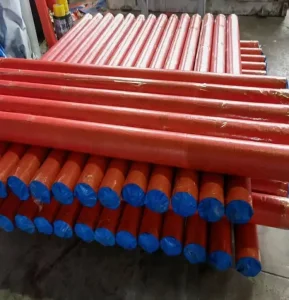
Our vertically integrated plant in Linyi, Shandong enforces an 8-stage manufacturing quality gate, ensuring every shipment bound for Hamburg meets international marine transport standards:
Engineering, procurement, and logistical details for buyers importing tarpaulins into Germany and Northern Europe.
Explore our complete range of PE, PP, and PVC protective tarpaulins engineered for global industrial, construction, and agricultural distributors.
Request factory-direct pricing, technical specification datasheets, and free sample swatches tailored for your European procurement requirements.
Send Inquiry Now