Explore our primary manufacturing outputs engineered for heavy agriculture, industrial waterproofing, and high-tenacity aquaculture pond construction.
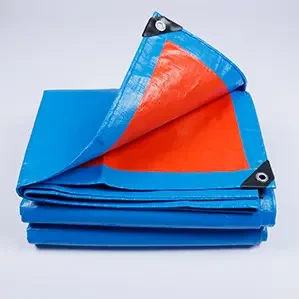
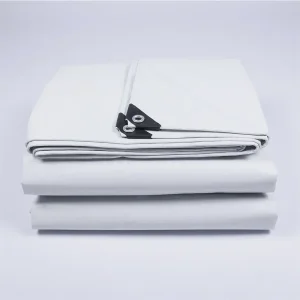
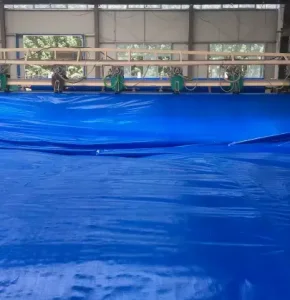
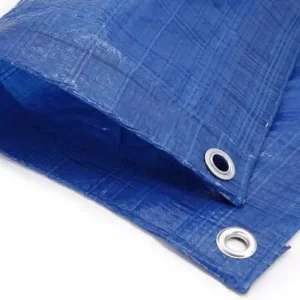
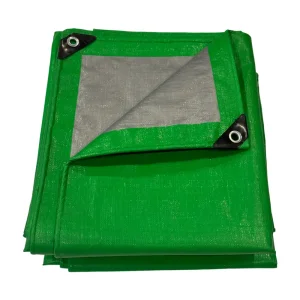
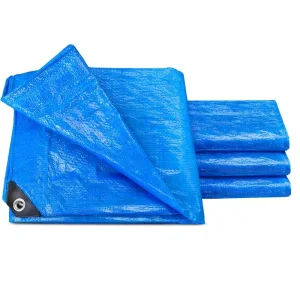
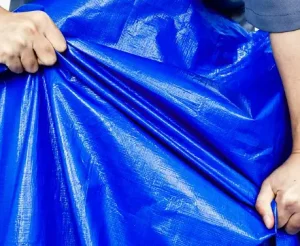
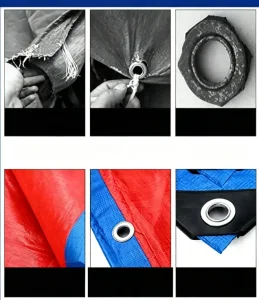
Modern commercial aquaculture is undergoing a rapid transition from traditional earthen ponds to controlled, high-density flexible polymer containment systems. As global water scarcity increases and biosecurity regulations tighten, professional fish farmers require containment solutions that eliminate soil-borne pathogens, prevent water seepage, and allow rapid deployment.
Traditional earthen pond excavation presents significant operational bottlenecks for commercial aquaculture enterprises:
Polyethylene (PE) and Polyvinyl Chloride (PVC) flexible tarpaulin fish ponds engineered by direct manufacturers solve foundational farming issues:
Selecting the correct raw polymer matrix is critical for long-term hydrolytic stability, UV resistance, and aquatic eco-toxicity safety. As an original equipment manufacturer (OEM), we engineer tarpaulin liners using non-leaching, non-toxic formulations certified for aquatic organisms.
| Performance Parameter | High-Density PE Tarpaulin (HDPE) | Heavy-Duty Coated PVC Canvas | Reinforced PP Fabric Tarpaulin |
|---|---|---|---|
| Target Application | Short-to-Medium Term Biofloc / Cost-Sensitive Ponds | Long-Term Commercial RAS / Frame Fish Ponds | Temporary Holding Tanks / Nursery Basins |
| Weight Range (GSM) | 160 GSM – 300 GSM | 500 GSM – 900 GSM (Custom up to 1200 GSM) | 120 GSM – 250 GSM |
| Hydrostatic Pressure Resistance | > 150 kPa | > 450 kPa | > 100 kPa |
| Tensile Strength (Warp/Weft) | 1200 N / 1100 N (per 5cm) | 3200 N / 2800 N (per 5cm) | 950 N / 850 N (per 5cm) |
| UV Degradation Resistance | 3% UV (2–4 Years Outdoor Rating) | 5% UV + TiO2 (5–10 Years Outdoor Rating) | 2% UV (1–2 Years Outdoor Rating) |
| Toxicity & Leaching Safety | 100% Virgin Food-Grade HDPE, Phthalate-Free | Non-Phthalate, RoHS & REACH Compliant PVC | Food-Grade Virgin Polypropylene |
| Thermal & Seam Welding | Hot-Air / Extrusion Weld (Double Seam) | High-Frequency (HF) Electro-Weld / Hot-Air | Heat Sealing with Reinforced Stitching |
Fish species such as Tilapia, Catfish (Clarias gariepinus), Trout, and Shrimp (Penaeus vannamei) are hypersensitive to chemical leaching. Cheap recycled plastic sheets leach heavy metals, plasticizers (DEHP), and toxic stabilizer additives into the water, resulting in high fingerling mortality. Our factory utilizes 100% virgin resin matrices paired with zinc-free organotin UV stabilizers.
The structural vulnerability of any tarpaulin pond lies within its seams. We utilize multi-kW High-Frequency (HF) dielectric welding machines and double-track hot air fusion seamers. The resulting welded joint possesses over 95% of the tensile strength of the parent material, preventing burst failures under high hydrostatic loads.
Commercial ponds experience dynamic stress from aerators, cleaning scrapers, and fish movement. Our heavy-duty PVC canvas incorporates an inner 1000D×1000D high-tenacity polyester woven scrim. This internal skeleton halts tear propagation even if sharp objects penetrate the outer polymer coating layer.
Sourcing custom tarpaulin fish ponds directly from Linyi, Shandong—China's premier plastic weaving and chemical manufacturing hub—delivers unparalleled structural cost advantages, quality consistency, and rapid production velocity for global importers.
Unlike trading intermediaries or partial converters, our Linyi industrial complex houses the complete manufacturing supply chain: High-speed tape extrusion lines, high-density circular looms, double-sided film lamination units, precision CNC cutting beds, automated grommet punching stations, and high-frequency welding bays. By maintaining total control over resin mixing, denier count, and coating thickness, we guarantee strict adherence to GSM specs with zero margin of error.
Situated with direct access to Qingdao Port and Lianyungang Port, our factory leverages China's most efficient logistics corridor. We offer optimized container loading (FCL) strategies, maximizing raw sheet weight and rolled canvas volume per 40ft High Cube container. This reduces ocean freight unit cost by up to 30% compared to fragmented regional suppliers in Southeast Asia or Europe.
Our engineering division manufactures specialized tarpaulin pond liners tailored to five main global commercial aquaculture formats.
Optimized for high-density microbial biofloc systems rearing Tilapia and Shrimp. Designed as a circular cylinder with a sloped conical bottom leading to a central waste discharge port. Diameter options range from 3 meters to 15 meters.
Features heavy-duty PVC tarpaulin fitted onto an external hot-dip galvanized steel mesh frame. Ideal for land-based farms requiring self-supporting structures above ground without civil excavation work.
Large-scale prefabricated PE or PVC tarpaulin sheets designed to line excavated earth basins. Provides quick, low-cost waterproofing for agricultural water storage and large-scale fish grow-out operations.
Rectangular high-tenacity canvas troughs specifically engineered for continuous water flow environments (e.g., Trout, Sturgeon, and intensive Catfish farming). Includes welded side-wall reinforcements.
Compact, lightweight folding tarpaulin units designed for fingerling acclimation, quarantine isolation, fry breeding, and quick emergency containment during pond maintenance cycles.
Double-coated, non-leaching polymer tanks designed to interface seamlessly with hydroponic plant beds, maintaining zero toxicity levels for nitrate-absorbing plants and aquatic life.
Aquacultural environments vary drastically across global geographic zones. Our chemical lab modifies raw masterbatch additive ratios to ensure localized survival against thermal, chemical, and mechanical stresses.
Challenges: Extreme Solar Irradiance (UV index 11+), high ambient humidity, elevated water temperature promoting biological growth, intense monsoonal squalls.
Factory Solution: Dosing with 4.5–5.0% Hindered Amine Light Stabilizers (HALS) and Titanium Dioxide ($TiO_2$) reflective coatings. Additive incorporation of non-migratory anti-fungal and anti-algal compounds to prevent microbial degradation of the PVC matrix.
Challenges: Severe day-night temperature fluctuations ($0^\circ C$ to $50^\circ C$), sandstorm mechanical abrasion, extreme thermal expansion/contraction.
Factory Solution: Utilization of plasticizers with wide thermal stability profiles (Flexibility maintained down to $-30^\circ C$ and structural rigidity up to $+70^\circ C$). Specially finished top-lacquer coatings (PVDF/Acrylic) that shed abrasive sand particles easily.
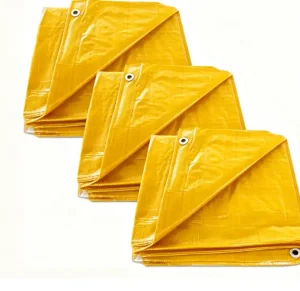
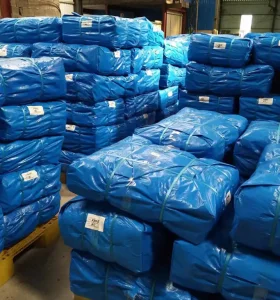
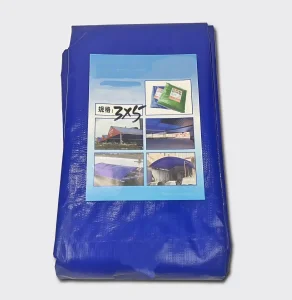
Explore additional factory-direct plastic woven sheets, UV-treated covers, and specialized custom tarpaulins manufactured for global trade buyers.
To ensure every batch of tarpaulin fish ponds fulfills international engineering requirements, our internal quality lab executes a rigorous 6-step testing cycle prior to factory release.
Testing membrane waterproof thresholds up to 500 kPa using hydrostatic pressure testers to ensure zero micro-porosity under extreme water depth conditions.
Verifying warp and weft breaking strength according to ISO 13934-1 standards. Ensures canvas withstands water pressure expansion without permanent deformation.
Exposing material samples to intense UV-A / UV-B light radiation cycles at elevated temperatures to simulate 3–8 years of severe sunlight exposure.
Immersing sensitive fry species in water tanks pre-treated with membrane samples for 14 days to certify zero chemical leaching or acute toxicity.
Subjecting welded joint seams to extreme shear tension to verify that thermal fusion integrity equals or exceeds parent material strength.
Measuring dynamic drop-cone puncture resistance to confirm durability against sharp rocks, equipment collisions, and heavy handling during site deployment.
Direct technical answers from our chief polymer chemical engineer and global trade team.
Whether you are a commercial aquaculture farm operator, regional agricultural distributor, or OEM brand owner, our Linyi production facility provides direct pricing, rigorous quality assurance, and engineered reliability.