Wholesale-ready, heavy-duty protective covers manufactured under strict ISO9001 quality management protocols.
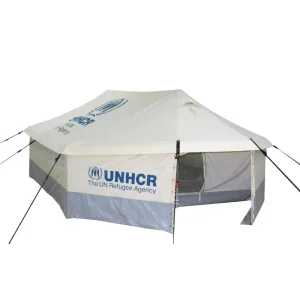
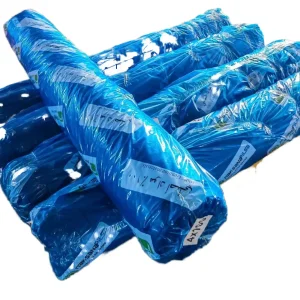
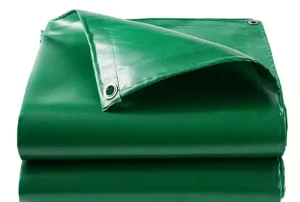
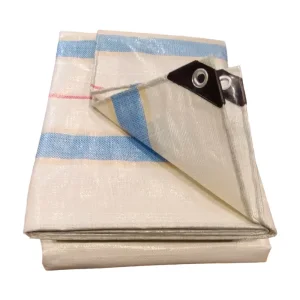
Strategic insights into key demand drivers, material transition trends, and international procurement standards across logistics, construction, and agricultural sectors.
The expansion of global commercial trade has heightened demand for high-tensile cargo covers. Fleet operators require multi-axial tear-resistant PE and PVC tarpaulins capable of surviving continuous highway wind stress, severe friction, and dynamic environmental changes during transcontinental transit.
Modern civil engineering relies heavily on temporary environmental enclosures, scaffolding containment sheets, and foundation waterproofing. Heavy-duty tarpaulins treated with flame-retardant (FR) additives and specialized UV blockers have become mandatory site safety components worldwide.
Agricultural operations face unprecedented weather volatility. High-density polyethylene tarpaulins featuring master-batch light stabilizers preserve livestock feed, cover grain bunkers, and protect high-value crops against hail, unexpected downpours, and intense solar radiation degradation.
Standard poly tarps suffer from photo-oxidation when exposed to solar Ultraviolet (UV-A and UV-B) radiation. Unstabilized polyethylene degrades within 90 days of continuous tropical exposure. Professional-grade tarpaulin manufacturing requires Hindered Amine Light Stabilizers (HALS) integrated directly into the molten HDPE tape extrusion phase, extending operational field life from 3 months to upwards of 5 years.
An engineering comparison of Polyethylene (PE), Polypropylene (PP), and Polyvinyl Chloride (PVC) architecture, lamination methods, and structural reinforcement options.
| Polymer Parameter | PE Tarpaulin (Polyethylene) | PP Tarpaulin (Polypropylene) | PVC Tarpaulin (Polyvinyl Chloride) |
|---|---|---|---|
| Base Fabric Core | Woven High-Density PE (HDPE) Tape | Woven High-Tenacity PP Tape | Woven High-Dtex Polyester Filament |
| Coating Lamination | Dual-side Low-Density PE (LDPE) Film | Dual-side Melt-extruded PP Layer | Paste PVC Knife Coating / Hot Lamination |
| Weight Range (GSM) | 60 g/m² – 300 g/m² | 70 g/m² – 280 g/m² | 400 g/m² – 900 g/m² |
| Tensile Strength (Warp/Weft) | 800 N / 1200 N per 5cm (200GSM) | 950 N / 1350 N per 5cm (200GSM) | 2500 N / 3000 N per 5cm (650GSM) |
| Hydrostatic Pressure | 10,000 mm H₂O – 15,000 mm H₂O | 8,000 mm H₂O – 12,000 mm H₂O | > 30,000 mm H₂O (100% Impermeable) |
| Thermal Endurance | -40°C to +80°C (Flexible in Frost) | -10°C to +100°C (Rigid Thermal Profile) | -30°C to +70°C (Heavy All-Weather) |
| Recyclability & Eco Profile | 100% Recyclable Polyolefin Stream | 100% Recyclable Polyolefin Stream | Requires Specialized PVC Reclamation |
Virgin HDPE resin granules mixed with master-batch colorants and UV anti-oxidants are melted, slit into fine continuous tapes, stretched under thermal control to align molecular chains, and wound onto spools to create maximum tensile yarn.
Utilizing advanced circular looms and water-jet weaving machines, the HDPE tapes are woven into structural mesh densities ranging from 6×6 to 14×14 threads per inch, determining structural tear resistance and burst pressure capability.
The woven mesh base passes through dual molten LDPE coating heads. Under heavy chill-roll pressure, liquid poly-film fuses into the weave gaps, forming a smooth, 100% moisture-impermeable barrier on both top and bottom surfaces.
How Linyi Xinshengyang Plastic Products Co., Ltd. leverages vertical integration, localized raw material clusters, and high-throughput automation to deliver global cost advantages.
Operating out of Wanggou Industrial Park in Linyi City—China’s premier logistics and plastics manufacturing hub—our 30,000 m² state-of-the-art facility processes resin granules directly into export-ready finished products. By maintaining total control over extrusion, weaving, double-sided coating, heat-sealing, rope-in-hem reinforcement, and eyelet punching, we eliminate sub-contractor markups and ensure absolute batch-to-batch consistency.
Our annual production output exceeds 20,000 metric tons of poly tarpaulins, supplying wholesale buyers, governments, and hardware retail distributors across 40+ countries.
Tailored poly tarpaulin specifications engineered to address regional climate friction, trade requirements, and site compliance.
Scaffolding & Winterization
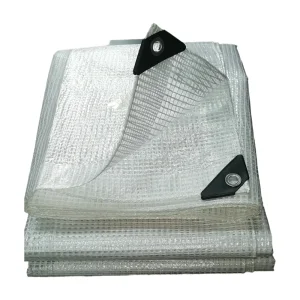
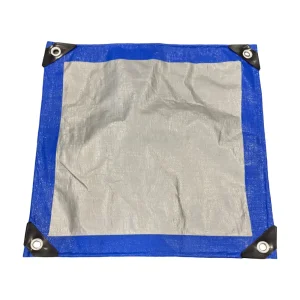
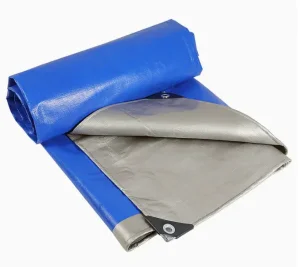
Heavy-duty 140–200 GSM blue/silver and clear grid PE tarpaulins designed to endure harsh sub-zero Northern winters. Includes rustproof aluminum grommets spaced every 18 inches for secure tying to scaffolding frames during building construction.
High-UV Solar & Oilfields
Heavy-weight 220–300 GSM silver/gold wrapped tarpaulins formulated with 5% HALS UV master-batch. Reflects thermal radiation, prevents thermal stress cracks under +50°C ambient desert weather, and protects oilfield supplies.
Eco & FR Scaffolding Standards
Fully REACH and RoHS compliant poly tarps. Available with B1/M2 fire-retardant (EN 13501-1) certification for municipal construction, featuring 100% recyclable mono-material polyolefin structure for green circular procurement.
Agriculture & Monsoon Protection
High-density 100–160 GSM green/black agriculture sheets engineered for high humidity and severe rainstorm resistance. Used extensively for crop drying, temporary grain silos, and aquaculture reservoir liners.
Rigorous laboratory verification processes ensure every batch meets precise tensile, tear, and waterproofing standards before shipping.
Verifies absolute lamination integrity under vertical water head pressures exceeding 15,000 mm H₂O, guaranteeing zero water seepage at welded center seams or corner patches during heavy storms.
Calibrated electronic tensiometers test fabric sample strips in warp and weft directions. Verifies that weave density and tape denier meet heavy-duty wind-load threshold requirements.
QUV chamber testing exposes poly fabric samples to intense UV condensation cycles. Measures tensile retention percentages to validate chemical master-batch formulation life before mass production.
Expert guidance for procurement managers, distributors, and supply chain directors sourcing tarpaulins from China.
Selecting the correct GSM depends directly on handling frequency, wind shear exposure, and required service life:
Cut Size refers to the dimensions of the raw flat tarpaulin sheet prior to perimeter finishing. Finished Size is the final measurement after the edges are folded inward over the PP reinforcement rope and heat-sealed. On average, the finished size is approximately 3% to 5% smaller (or 10cm–30cm less) than the nominal cut size. Our factory provides both options depending on your market's labeling conventions.
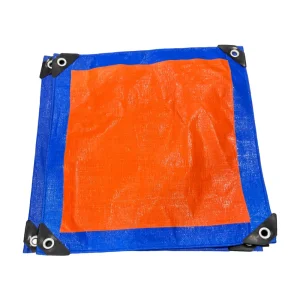
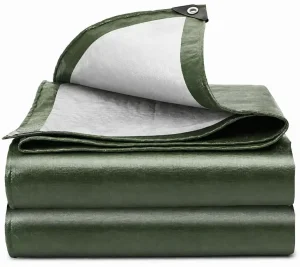
For standard stocked color formulations (e.g., Blue/Silver, Green/Silver, Blue/Orange), our MOQ starts at 3 metric tons per specification. For custom GSM, unique color combinations, or full private-label retail packaging, our base MOQ is one 20ft container (approx. 11–13 tons). We support mixed-container loads combining finished PE sheets, rolls, PP woven fabric, and PE layflat irrigation hoses within a single shipment.
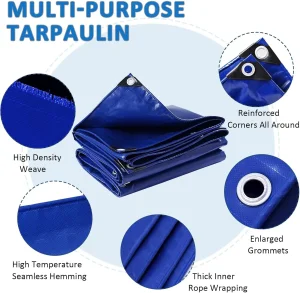
Corner eyelet pull-out is the primary point of field failure in low-grade tarps. We engineer structural stability by inserting molded black plastic triangular patches at all four corners, doubling the underlying fabric layers, and welding a continuous polypropylene (PP) reinforcing cord inside the entire heat-sealed hem prior to pressing heavy-duty aluminum or brass grommets.
We execute orders under FOB Qingdao/Lianyungang, CFR, CIF, and DDP terms. Full export documentation includes Commercial Invoice, Packing List, Bill of Lading, Certificate of Origin (Form E for ASEAN, Form A, CO), SGS/BV pre-shipment inspection certificates, and REACH/RoHS chemical safety declarations on request.
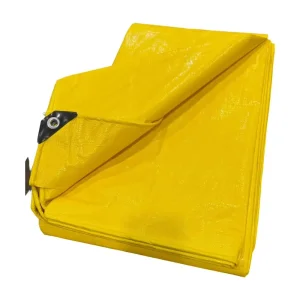
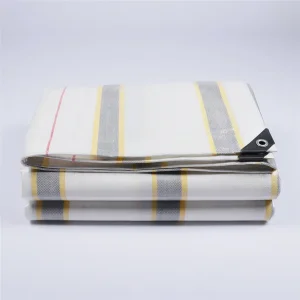
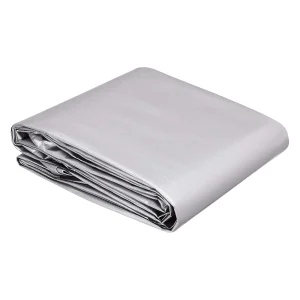
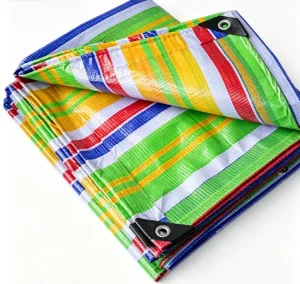
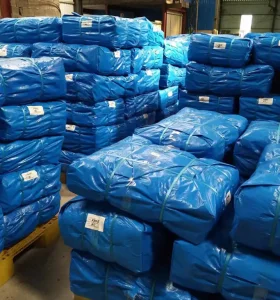
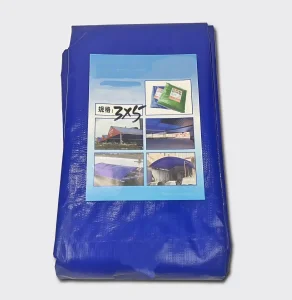
Complete catalog of reinforced, weather-proof tarpaulin sheets and fabric rolls ready for international shipment.
Contact our export engineering team to receive complete technical data sheets, sample swatch kits, and container-load pricing estimates tailored to your destination port.