Direct-from-factory polyolefin solution engineered for heavy-duty UV rejection, waterproofing, and structural durability.
Analyzing global climate volatility, solar radiation indexes, and the shifting procurement benchmarks for sun-proof fabric manufacturing.
Ultraviolet (UV) radiation—specifically UV-A (315–400 nm) and UV-B (280–315 nm)—causes catastrophic photo-oxidation in standard polyolefin materials. Solar energy induces free-radical cleavage along carbon-polymer chains, causing discoloration, embrittlement, and structural cracking. Industrial end-users across North America, the Middle East, and Australia now demand mandatory UV-stabilization formulations capable of retaining over 80% tensile strength after 3,000 hours of accelerated Xenon arc exposure.
Procurement requirements are no longer restricted to basic tarp covers. Modern enterprise buyers seek targeted material formulations for multi-industry deployment. Agricultural operators require infrared-reflective greenhouse film and crop shields; global logistics fleets demand 650–900 GSM scratch-resistant PVC trailer curtains; temporary shelter networks require flame-retardant (NFPA 701 / DIN 4102 B1) shelter membranes for disaster response.
Global supply chains face tightening environmental mandates. Buyers in the EU and North America require strict compliance with EU REACH, RoHS, and PFAS-free waterproofing regulations. Forward-thinking Chinese manufacturing hubs have migrated toward 100% recyclable Polyethylene (PE) woven constructs and eco-friendly plasticizers, enabling enterprise buyers to meet ESG goals without compromising thermal or hydrostatic performance.
SEO Information Gain Insight: Unlike standard retail sheets, industrial sun-proof polymer fabrics engineered in China's advanced manufacturing hubs integrate complex Hindered Amine Light Stabilizers (HALS) alongside titanium dioxide ($TiO_2$) and carbon black agents. This chemical synergy prevents polymer backbone scission during prolonged high-kelvin solar exposure.
How Shandong's automated textile and plastic clusters deliver vertical integration, precision quality control, and unparalleled scale efficiency.
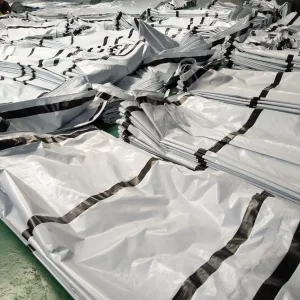
The structural competitiveness of China's top-tier sun-proof factories relies on complete vertical integration. Spanning facility footprints exceeding 30,000 square meters, modern production plants in industrial hubs such as Linyi, Shandong maintain direct control over every step of the manufacturing chain:
This end-to-end processing eliminates third-party outsourcing markups, stabilizes gram-per-square-meter (GSM) weight tolerances within ±2%, and ensures batch-to-batch color and UV consistency.
Ensures Delta E (ΔE) color variation remains under 1.0 across 50,000+ meter production runs.
Verifies waterproof integrity up to 10,000 mm $H_2O$ column according to ISO 811 standards.
ASTM D751 grab method testing verifying warp tear strength up to 350 N and tensile limits over 1200 N/5cm.
Continuous QUV testing cycles (ASTM G154) simulating 3 to 5 years of harsh outdoor exposure.
Proven operational metrics from leading sun-proof polyolefin factories supplying overseas enterprise buyers.
Objective comparison parameters for B2B procurement officers evaluating PE, PP, and PVC outdoor industrial covers.
| Performance Criterion | PE Coated Tarpaulin (Polyethylene) | PP Woven Tarpaulin (Polypropylene) | PVC Coated Tarpaulin (Polyvinyl Chloride) |
|---|---|---|---|
| Weight Range (GSM) | 60 g/m² – 300 g/m² | 70 g/m² – 220 g/m² | 400 g/m² – 900 g/m² |
| UV Degradation Half-Life | 3–5 Years (with HALS Masterbatch) | 1.5–3 Years (Moderate UV Resistance) | 5–10 Years (Extreme Photothermal Resistance) |
| Hydrostatic Pressure Rating | 5,000 mm to 10,000 mm $H_2O$ | 3,000 mm to 6,000 mm $H_2O$ | > 15,000 mm $H_2O$ (100% Impermeable) |
| Flexural Crack Temperature | -40°C to +80°C (Outstanding Cold Flexibility) | -10°C to +90°C (Higher Heat Deflection) | -30°C to +70°C (Requires Cold-Crack Additives) |
| Abrasion & Scratch Resistance | Moderate to High | Moderate | Exceptional (Knife-Coated Polymer Matrix) |
| Environmental Recyclability | 100% Recyclable (Single-Polymer PE Family) | 100% Recyclable (PP Stream) | Requires Specialized PVC Recovery Processing |
| Primary Target Application | Agriculture, Cargo Covers, Roof Repair, General Tarping | Short-term Scaffolding, Weed Control, Heavy Sacks | Truck Side Curtains, Architectural Tents, Oil Booms |
Customized specs matched to environmental challenges across key global commercial sectors.
Flatbed trailers, intermodal container covers, and side-curtain trucks operating in high-UV regions (e.g., Middle East GCC transit routes, Australian Outback corridors) require heavy-duty PE and PVC covers engineered with reinforced rope hems, anti-billowing eyelets, and tear-stop grid mesh to survive continuous wind shearing and solar bombardment.
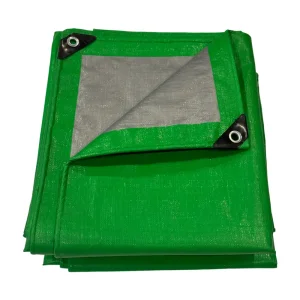
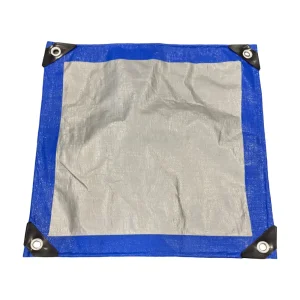
For grain stockpiles, hay bale protection, and greenhouse side curtains, custom multi-color laminated tarps (such as Black/Silver or Green/Silver) reflect solar radiation, maintain internal thermal stability, prevent condensation buildup, and block light transmission to suppress weed proliferation and crop spoilage.
High-rise scaffolding enclosures, temporary roofing membranes, and concrete curing blankets require high-tensile 150–250 GSM flame-retardant sheeting. Fire-inhibiting compounds (meeting UL94 or NFPA 701) are incorporated directly into the LDPE coating layer to ensure site safety compliance.
An operational quality assurance framework for sourcing directors and supply chain managers.
Substandard suppliers frequently substitute virgin HDPE with unrefined post-consumer regrind polymer, causing micro-voids and rapid UV degradation. Professional buyers should demand Differential Scanning Calorimetry (DSC) reports to verify thermal properties and confirm melt flow index (MFI) consistency before order placement.
The structural integrity of a large-format sun-proof cover is defined by its hot-air welded seams. Ensure the factory utilizes multi-stage digital temperature control on hot-air sealing lines. Weld strength must match or exceed 90% of the virgin base fabric's tensile yield to prevent seam separation under high wind loads.
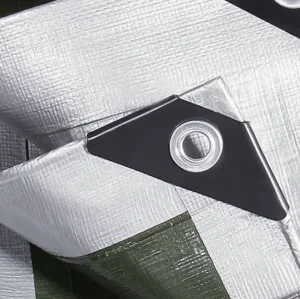
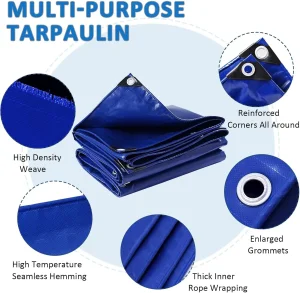
Grommets represent primary failure points during extreme weather events. Audit whether the facility installs heavy-duty polycarbonate or molded rubber triangular corner reinforcements beneath aluminum/brass eyelets. Standard pitch spacing should be strictly calibrated to 50 cm or 100 cm intervals with inner poly-rope perimeter hem reinforcements.
Never accept unverified verbal lifespan claims. Request documented lab exposure test records (ISO 4892-3 or ASTM G154). Reliable manufacturers provide third-party verification from international agencies (SGS, Intertek, or BV) demonstrating retention of breaking force after 1,500+ hours of continuous UV-B radiation cycles.
Detailed answers to essential technical and commercial questions raised by international procurement teams.
UV masterbatch concentration (typically 1% to 5% by weight) directly determines polymer longevity under intense solar exposure. In high-radiation zones such as the Middle East (GCC), North Africa, and Northern Australia—where annual solar radiation exceeds 180–200 Kly (Kilolangleys)—a minimum 3% to 5% Hindered Amine Light Stabilizer (HALS) formulation is required. This chemical additive neutralizes free radicals created by UV photons, extending the fabric's outdoor service life from 6 months to 3–5 years without severe brittle fracturing.
Cut size refers to the raw dimensions of the woven fabric panel prior to edge hem folding, corner reinforcement, and perimeter heat sealing. Finished size represents the actual final dimensions of the delivered tarp after a standard 3% to 5% hem folding loss (typically 10–20 cm reduction along each edge for perimeter rope insertion). Leading Chinese factories explicitly declare both Cut Size and Finished Size on shipping cartons and specification sheets to prevent commercial discrepancies.
Unlaminated woven fabric provides mechanical tensile strength but lacks liquid impermeability and air barrier performance; water can easily penetrate warp and weft interlock voids. Double-sided Low-Density Polyethylene (LDPE) extrusion coating applies a uniform 20 to 45 micron molten film on both surfaces, completely sealing the woven structural core. This creates 100% hydrostatic waterproofing, prevents pinhole leakage, enhances abrasion resistance, and lock-in UV additives within the core matrix.
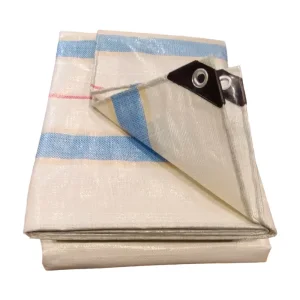
For standard stocked color rolls and ready-made sizes (e.g., Blue/Silver 100 GSM or Green 120 GSM), factory MOQs start at 3 metric tons or one mixed 20ft FCL container. For custom Pantone color matching, specialized UV dosage (e.g., 5% HALS), custom brand label printing, and bespoke eyelet spacing, the minimum run is typically 5 to 10 metric tons per specification. Standard production lead time ranges from 15 to 25 calendar days following artwork confirmation and deposit clearance.
Top-tier Chinese sun-proof factories enforce strict raw material receiving inspection (IQC). Heavy metals (Lead, Cadmium, Hexavalent Chromium), toxic plasticizers (Phthalates), and hazardous waterproofing agents (PFAS/PFOA) are screened out. Export product lines are regularly submitted to SGS, Intertek, or TUV testing to certify compliance with EU REACH Regulation (EC No 1907/2006), California Proposition 65, and US FDA non-food contact safety guidelines.
Explore customized specifications, specialized weave mesh counts, and heavy-duty industrial fabric options.
Connect directly with our engineering department to configure your material specs, request lab test validation (SGS/BV), and calculate container loading optimization.